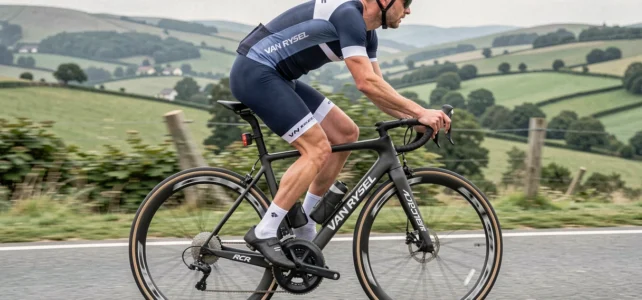
On a a hilly cyclosportive or a club ride averaging over 35 km/h, the choice of transmission group significantly changes the way one rides a Van Rysel RCR. Shimano Di2 and SRAM AXS do not just offer two different logos on the shifters: ergonomics, autonomy, shifting speed, and control logic differ enough for a demanding cyclist to find food for thought before making a decision.
Latency and shifting speed: what changes on the ground between Di2 and AXS
When accelerating out of a turn or tackling a steep incline, the speed of gear change is not a detail. Available measurements show that Shimano Di2 has a latency of about 120 ms at the rear derailleur, compared to about 190 ms for SRAM AXS. The difference seems small on paper, but it is felt during quick shifts under load.
The front chainring shift deepens the difference further: about 220 ms for Shimano, compared to about 380 ms for SRAM AXS. On a lively course with frequent accelerations, Shimano Di2 offers a noticeable responsiveness when shifting chainrings and cogs within the same second. We conducted the Van Rysel RCR comparison between Sram and Shimano on hilly profiles, and it is precisely in these sequences that the difference becomes apparent.
SRAM AXS compensates with a different control logic. The two buttons on each shifter (one for upshifting, one for downshifting) allow for a sequential mode where the rear derailleur and front chainring coordinate automatically. For cyclists who prefer not to think about their gear combinations while exerting effort, this is a tangible advantage.
Battery life: a decisive factor for long rides
On a block of stages or a week of consecutive climbs, the autonomy of the transmission weighs heavily in daily organization. Shimano Di2 claims between 1,500 and 2,000 km per charge, with a central battery housed in the seat tube. You plug the bike in once every two to three weeks with regular use, and you don’t think about it anymore.
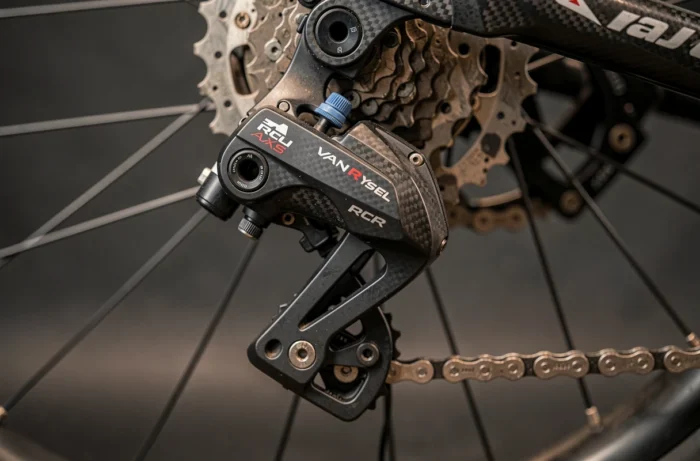
SRAM AXS operates with CR2032 button batteries (or rechargeable batteries depending on the version) installed on each derailleur. The autonomy is around 60 to 80 hours of riding, or about 1,000 km. This is sufficient for most practices, but cyclists who go through blocks of stages must monitor their levels more frequently.
The positive point of the SRAM system: in case of a derailleur failure, you can replace the battery roadside in a few seconds. With Shimano Di2, if the central battery fails, both derailleurs stop simultaneously. Feedback varies on this point, with some riders never having encountered the problem over several thousand kilometers.
Weight of the group and impact on a Van Rysel RCR frame
The Haut Module carbon frame of the RCR is claimed to weigh 830 g in size M, while the RCR PRO is 790 g. On such a lightweight machine, every gram of transmission counts. In the mid-range, a complete Shimano Ultegra Di2 group is slightly lighter than a complete SRAM Force AXS, with a difference of a few tens of grams.
This difference is not felt on short climbs. On a long climb where the cumulative weight plays progressively, the difference remains marginal compared to the choice of wheels or tires. The Zipp 303 SW wheels offered on some high-end SRAM builds more than compensate with their aerodynamic profile and lateral stiffness.
What really weighs in the balance
- SRAM AXS XG cassettes made of steel and aluminum are often lighter than their Shimano equivalents with the same range, which reduces part of the gap at the complete group level.
- The SRAM crankset with integrated power meter (available on some RCR builds) adds functionality without adding weight to the bike with an external sensor.
- The hydraulic brakes from both brands are comparable in weight, but SRAM levers are more compact, which may suit smaller hands.

Shimano or SRAM on Van Rysel RCR: concrete selection criteria
The choice is not just a matter of pure performance. It also involves compatibility with the cyclist’s existing ecosystem and their riding habits.
- Shimano Di2 is better suited for riders who want maximum autonomy, reduced latency in gear changes, and who come from a mechanical Shimano group (the lever logic remains the same).
- SRAM AXS targets cyclists who appreciate automated sequential shifting, native Bluetooth connectivity with computers, and the modularity of independent batteries.
- For mixed use of cyclosportive and training, Shimano offers less software maintenance (no firmware updates to monitor as often), while SRAM offers more customization via the AXS app.
Available builds and prices
On the market, the majority of Van Rysel RCRs are still equipped with Shimano (105, Ultegra, Dura-Ace). SRAM builds (Rival, Force, Red AXS) are available depending on the markets and versions. The RCR PRO in SRAM Force AXS is positioned in the high range, with a performance/price ratio that remains competitive compared to competing frames sold at significantly higher prices.
The RCR frame accepts both standards without adapter or mounting compromise. Therefore, you can buy an RCR in Shimano and migrate to SRAM later (or vice versa), provided you change the entire group. The frame does not lock any transmission choice, which protects the investment in the long term.
The last criterion to decide remains tactile: before ordering, visiting a Decathlon store to handle both types of shifters on an exposed RCR allows you to feel the lever travel, the click resistance, and the button positions. It is often there, hands on the handlebars, that the decision is truly made.