
The concept of a private enjoyment space generates recurring misunderstandings in co-ownership. A co-owner discovers that their parking space, terrace, or piece of garden does not match the dimensions indicated in the official documents of the building. The question of size compliance arises, but it does not fall under property rights or a simple tape measure on the ground.
Co-ownership regulations and descriptive state of division: the only reference documents
Verifying the size of a private enjoyment space begins with reading the co-ownership regulations and the descriptive state of division (EDD). These two documents legally establish the extent of the rights granted to the co-owner.
The EDD describes each lot, sometimes with dimensions or references to an attached plan. The co-ownership regulations specify the conditions of use.
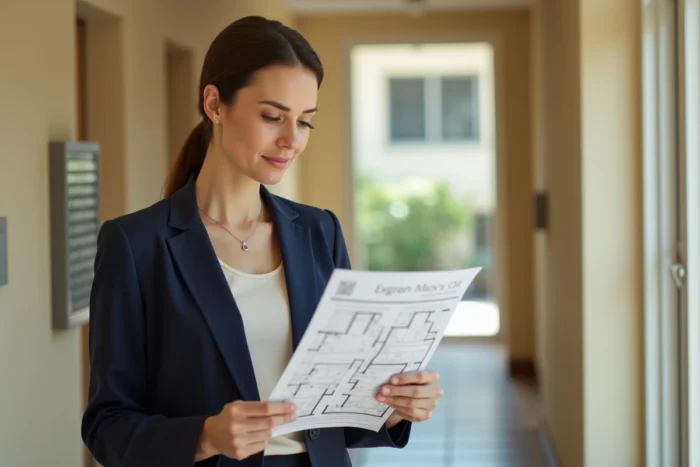
When a plan is attached to the regulations, it serves as the key document. It graphically delineates the area allocated for private enjoyment. In the absence of a dimensioned plan, the literal description in the deed prevails, which leaves a sometimes wide margin for interpretation. Field reports vary on this point: some older regulations only provide vague mentions (“the courtyard adjacent to lot 3”), without any dimensions.
The notion of private enjoyment space in co-ownership law is based on a clear principle established by the ELAN law of 2018: private enjoyment cannot constitute the private part of a lot. The co-owner benefits from a right of use, not a right of ownership over the land. Therefore, verifying the size amounts to comparing the actual area occupied with what the deeds describe, not claiming an area as personal property.
On-site compliance check: a practical method
Once the documents are retrieved from the property manager or notary, the physical verification work can begin. Two situations arise depending on the quality of the available documents.
When a dimensioned plan exists
The co-owner can measure the concerned space themselves and compare it with the dimensions listed on the attached plan. A discrepancy of a few centimeters often falls within construction tolerances. However, a significant deviation (a parking space shortened by a pole or wall added after construction) warrants reporting to the property manager.
For contentious cases, involving a surveyor provides an opposable measurement. The surveyor’s report constitutes the strongest technical evidence in case of a dispute before the judicial court.
When no precise plan exists
The situation becomes more complicated. The co-ownership regulations sometimes mention an approximate area or a simple location. In this case, compliance is judged against historical usage and existing physical boundaries (walls, fences, ground markings). The available data do not always allow for a definitive conclusion, and this is where disputes take root.
Several elements can support the verification:
- The original building permit plans, available at the town hall’s urban planning department, which show the initial configuration of the building and its surroundings.
- The minutes of general meetings, which may mention works that altered the configuration of the common areas (demolition of a wall, construction of a technical room, reconfiguration of parking spaces).
- The successive sale deeds of the concerned lot, which sometimes include a more detailed description than the initial regulations.
Article 6-3 of the 1965 law and limits of size control
Article 6-3 of the law of July 10, 1965, created by the ELAN law of 2018, established a clearer legal framework for common areas for private enjoyment. This text ended an old ambiguity: a right of private enjoyment remains an accessory to the lot, never a private part.
This qualification has direct consequences on the question of size. If a co-owner finds that the area actually used exceeds that described in the deeds, they cannot claim adverse possession (usucapion) to appropriate the surplus. The Court of Cassation has repeatedly confirmed that private enjoyment, regardless of the time elapsed, does not transform into ownership rights.
Conversely, if the space is smaller than expected (for example, because a common facility has been installed on a portion of the area), the co-owner can contest this reduction at the general meeting. Modifying the extent of a right of private enjoyment generally requires a vote by the majority specified in Article 26 of the law, or even unanimity in certain cases.
Bringing co-ownership regulations into compliance: the procedure to follow
Co-ownerships built before 2018 have not all incorporated the distinction established by Article 6-3. Bringing regulations into compliance with provisions regarding common areas for private enjoyment remains an ongoing task for many co-ownership associations.
In practical terms, compliance follows a multi-step process:
- Identify in the existing regulations all mentions of rights of private enjoyment, including those stated ambiguously (“exclusive use,” “particular enjoyment,” “reserved for the lot”).
- Verify that each right of enjoyment is indeed attached as an accessory to a specific lot, with a sufficient description of its footprint.
- Submit the modification of the regulations for a vote at the general meeting, according to the majority required by the nature of the modification.
- Publish the modified regulations at the land publicity service to make it opposable to third parties.
The cost of this compliance (surveyor, notary, publication) is borne by the co-ownership as a whole, unless the general meeting decides otherwise regarding the distribution of charge shares.
Verifying the size of a private enjoyment space relies on precise documentary work, cross-referenced with a physical survey. The co-ownership regulations and the descriptive state of division remain the only opposable references.
A co-owner who discovers a discrepancy between reality and the deeds has avenues for recourse but can never transform a surplus area into ownership rights. This is the structural limit of this type of verification, and it also underscores the necessity of carefully reading the deeds before any purchase.