The fracture of the sacrum remains an underestimated injury in pelvic trauma. Its impact on the sacral roots S2 to S4 requires a rehabilitative approach that goes far beyond simple muscle reconditioning: sphincter disorders, pelvic floor dysfunctions, and instability of the sacroiliac joint must be integrated from the initial assessment.
Monitoring of the sacral roots and perineal rehabilitation after sacral fracture
We often observe that the neurological component takes a back seat in pelvic rehabilitation protocols. A fracture crossing the sacral foramina can compress or stretch the S2 to S4 roots, responsible for the innervation of the pelvic floor, bladder, and anal sphincter.
A systematic perineal assessment is recommended from the initial phase. It includes the evaluation of perineal muscle testing, the search for perineal hypoesthesia in the saddle area, and a targeted interview regarding any urinary leaks or sexual disorders.
Perineal rehabilitation should begin before the resumption of independent walking, to avoid chronicizing sphincter disorders. Pelvic floor work combines voluntary analytical contractions (adapted Kegel type), perineal biofeedback, and coordination with the transverse abdominal muscle. This approach, still little detailed in content aimed at the general public, is crucial for long-term quality of life.
To structure this phase, rehabilitation after sacral fracture benefits from following a protocol that integrates the perineal aspect from the outset with the musculoskeletal aspect.
Early loading and management of pelvic deconditioning

Early partial weight-bearing significantly reduces the risk of global deconditioning. The current trend in pelvic trauma moves away from prolonged strict bed rest as soon as fracture stability allows, typically after radiological confirmation of the absence of secondary displacement.
The transition from lying down to standing follows a controlled progression:
- Bed mobilization with vascular pump exercises (ankle flexion-extension, isometric contractions of the quadriceps and glutes) to limit the risk of phlebitis and muscle wasting
- Assisted standing with partial weight-bearing using two crutches, respecting pain as an indicator of mechanical overload on the sacrum
- Transition to progressive full weight-bearing, guided by radiological control of consolidation and clinical tolerance during walking
We recommend not waiting for complete consolidation to engage the pelvic muscle chains. The gluteus medius, psoas, and transverse abdominal muscle can be worked isometrically and then with light concentric contractions well before resuming walking without technical assistance.
Strengthening of pelvic stabilizers and proprioceptive work in closed chains
The sacrum is the keystone of the pelvic ring. Its fracture destabilizes the entire lumbopelvic mechanics. The strengthening of pelvic stabilizers conditions the quality of functional recovery.
The exercises target four priority groups:
- The gluteus medius, a frontal stabilizer of the pelvis, worked in lateral decubitus (abduction against gravity) and then in progressive single-leg loading
- The iliopsoas, whose shortening post-immobilization limits hip flexion and alters lumbar lordosis
- The transverse abdominal muscle, which ensures the locking of the abdominal box during transfers and walking
- The pelvic floor, in synergy with the transverse, to restore continence and perineal stability
Proprioceptive work in closed chains (half-squats, controlled forward lunges, single-leg support on stable then unstable surfaces) occurs once full weight-bearing is achieved. This step is often overlooked, yet it directly prepares for the resumption of sports and the prevention of residual sacroiliac pain.
Sacroiliac mobility and specific exercises
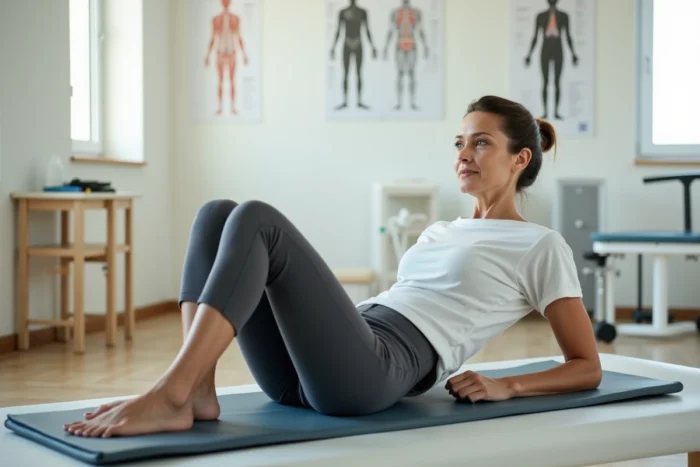
Stiffness of the sacroiliac joint post-fracture frequently generates referred low back pain. Gentle mobilizations in nutation and counter-nutation of the sacrum, performed in quadruped or supine position (knees bent, anterior-posterior pelvic tilt), help restore joint play without excessive strain on the fracture site.
Stretching of the piriformis and external hip rotators complements this work. A contracted piriformis after immobilization compresses the sciatic nerve at the level of the greater sciatic notch, which can mimic or worsen residual sciatica.
Return to sports after sacral fracture: criteria and timelines
The decision to resume sports is not based on a calendar timeline but on validated functional criteria. We expect the meeting of several conditions: prolonged painless walking, stable single-leg support held for at least thirty seconds, absence of pain upon palpation of the sacrum and sacroiliac groove, and gluteus medius testing rated at least four out of five.
Rehabilitation in an aquatic environment (hydrotherapy, deep water walking) provides a relevant transition between dry physiotherapy and return to the field. The buoyancy of water reduces mechanical stress on the pelvis while allowing for overall cardio-respiratory and muscular work.
The return to impact sports (running, team sports) occurs last, after a phase of progressive re-athleticization including stationary cycling, swimming, and gym strengthening. Any episode of sacroiliac or low back pain during load increase necessitates a temporary return to the previous step.
The fracture of the sacrum involves a more technical rehabilitation process than it appears. Early consideration of the pelvic floor, targeted strengthening of pelvic stabilizers, and adherence to strict functional criteria before resuming sports make the difference between complete recovery and established sequelae.