What distinguishes a great Loire estate from a simple regional producer? The answer lies as much in historical depth as in winemaking choices. The Loire Valley, with its dozens of appellations and emblematic grape varieties, is home to houses whose roots sometimes go back several centuries. Measuring this heritage requires comparing the terroirs, grape varieties, and methods that shape each cuvée.
Chenin blanc and cabernet franc: two grape varieties, two interpretations of the Loire terroir
The Loire vineyard stretches over several hundred kilometers, from Nantes to Sancerre. This length generates a diversity of soils and microclimates that two major grape varieties exploit in radically different ways.
| Criteria | Chenin blanc | Cabernet franc |
|---|---|---|
| Preferred area | Vouvray, Montlouis, Savennières | Chinon, Bourgueil, Saumur-Champigny |
| Preferred soil type | Limestone tuffeau, flint clay | Gravel, sand on tuffeau |
| Aromatic profile | Citrus, quince, honey (depending on sweetness) | Red fruits, bell pepper, violet |
| Possible wine styles | Dry, semi-dry, sweet, sparkling | Light to full-bodied red, rosé |
| Aging potential | Very high (several decades for sweet wines) | Moderate to high depending on the cuvée |
Chenin blanc stands out for its ability to produce all styles of wine, from sparkling brut to late harvest sweet wines. No other French white grape variety offers such a wide spectrum from a single variety.
Cabernet franc, on the other hand, emphasizes finesse rather than power. On the tuffeau soils of Chinon or Saumur-Champigny, it produces reds with silky tannins, far from the more rustic versions found in Bordeaux.
A historic estate in Touraine like the Philippe Brédif house, whose winemaking activity dates back to the 19th century, illustrates this relationship between grape variety and terroir well. The Vouvray cuvées produced from chenin blanc on limestone tuffeau showcase the full range of the grape, from fine bubbles to still wines. The entire range of vintages and cuvées is indeed referenced on the Philippe Bredif website, allowing one to follow the stylistic evolution of the house over several decades.
Montlouis-sur-Loire vs Vouvray: a historical split that sheds light on great estates
The Vouvray appellation was born in 1936. Two years later, in 1938, the winemakers on the left bank of the Loire obtained their own AOC: Montlouis-sur-Loire. This separation is not merely administrative.
The Montlouis producers, more rural, refuse to be integrated into an appellation perceived as bourgeois. The split reflects a social opposition as much as a geographical one. The soils differ slightly (more sand and gravel on the left bank), and the style of the wines does too: the chenin from Montlouis tends towards drier profiles and more taut sparkling wines.
This rivalry has shaped the identity of each bank. A great estate in Vouvray like Philippe Brédif has built its reputation on age-worthy wines, with a minerality linked to the limestone tuffeau of the right bank. The Montlouis estates, on the other hand, have focused on freshness and showcasing their troglodytic cellars.
- Vouvray favors still age-worthy wines, semi-dry and sweet, with aging potential of several decades
- Montlouis emphasizes traditional method sparkling wines and lively dry wines, often more accessible when young
- Both appellations share chenin blanc as the sole grape variety, but yields and pressing methods vary from one estate to another
Understanding this duality helps to read the Loire wine map with greater precision. The appellation alone does not tell the whole story: the choice of estate and its history determine the style of the wine.
Troglodytic heritage and winemaking: what tuffeau brings to wine
The tuffeau cellars are not a tourist backdrop. They play a measurable technical role in the aging of Loire wines.
Tuffeau, a soft limestone rock, maintains a stable temperature around twelve degrees all year round and a naturally high humidity level. These conditions slow down the evolution of wine in the bottle and limit oxidation during barrel aging.
For the sparkling wines of Vouvray or Montlouis, this thermal stability is crucial. The secondary fermentation in the bottle, which can last several months, requires a constant temperature for the fermentation to be consistent. A deviation of a few degrees is enough to alter the finesse of the bubbles.
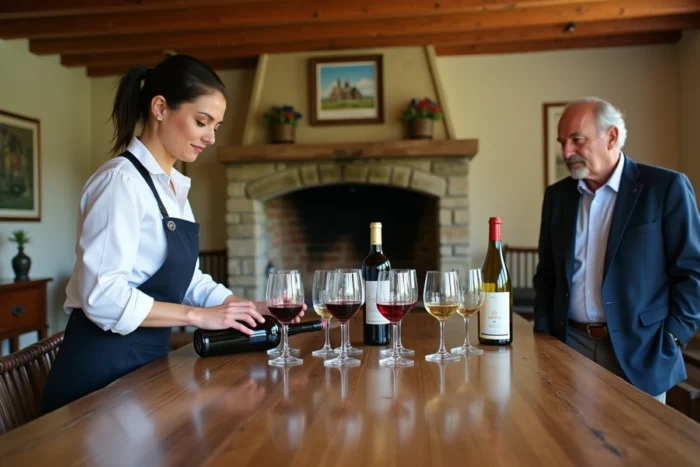
The great estates of Touraine have been exploiting these galleries for centuries. Some cellars extend several hundred meters into the rock, with networks originally dug to extract building stone for the châteaux of the Loire. The built heritage and the wine heritage literally share the same rock.
The wine tourism enhancement of these cellars has accelerated since the late 2000s. In Montlouis, the local cooperative created a welcome and tasting area in 2008 integrated into the troglodytic network. This staging of the underground heritage transforms the cellar visit into a geological and historical narrative, well beyond mere tasting.
Reading a Vouvray label: the clues that the visitor overlooks
A bottle of Vouvray can contain a dry, semi-dry, sweet, or sparkling wine. The mention on the label remains the only reliable indicator, and it is often discreet.
- The mention “dry” indicates less than 4 grams of residual sugar per liter, a lively and mineral wine
- “Semi-dry” corresponds to a wider range, with a perceptible sweetness that balances with the acidity of the chenin
- “Sweet” signals a late harvest wine, rich and concentrated, intended for aging
- “Brut” or “traditional method” designates a sparkling wine made like a crémant, with secondary fermentation in the bottle
A historic estate often produces these four styles simultaneously, depending on the plots and vintages. The vintage influences the style as much as the winemaker: a warm year favors sweet wines, while a cool year leans towards dry and sparkling wines.
This versatility of chenin blanc explains why the great estates of Vouvray maintain libraries of old vintages. Some sweet cuvées remain remarkable after several decades, a longevity that few French white wines can claim outside of Burgundy or Alsace.
The diversity of styles produced on the same estate remains one of the most reliable markers of authentic Loire know-how. It is also what makes tasting on-site, in the tuffeau cellars, more informative than a simple purchase in a shop.