Wedding decoration today reflects a tension between two contradictory desires: to create a visually coherent setting and to incorporate a personal story. The content available online often provides lists of ideas categorized by theme or season, without addressing the concrete mechanics that allow one to transition from an inspiration board to a fully decorated venue.
What distinguishes personalized decoration from generic decor rarely hinges on budget, but rather on the method of selection and the prioritization of areas within the reception.
Wedding decor guiding principle: limit materials for greater elegance
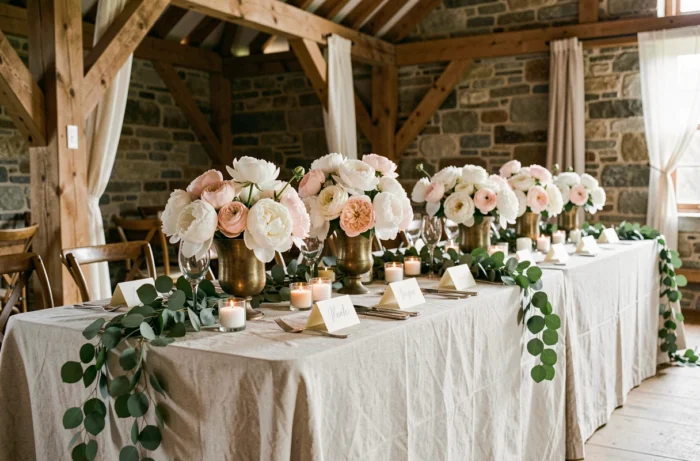
The visual coherence of wedding decoration relies on a deliberate constraint. Several recent approaches recommend reducing the palette to two or three colors and one dominant material. Raw wood paired with ecru linen, or clear glass combined with golden accents, are enough to set a mood without overcrowding the space.
A common mistake is to accumulate elements found separately on inspiration platforms, without checking their compatibility once gathered. A kraft paper place card, a satin tablecloth, and a chrome metal centerpiece may each work in isolation, but their coexistence produces a decor without direction.
The guiding principle extends beyond colors. It also includes textures (matte or shiny, smooth or grainy) and proportions (small scattered objects or large spaced pieces). Setting these parameters before selecting any element avoids impulsive purchases and last-minute returns. Browsing the decor on Mariage et Décoration allows for visualizing material associations already tested in real reception contexts.
Wedding decoration budget: focus efforts on three key areas
Uniformly decorating an entire room is expensive and dilutes visual impact. Field feedback converges on a strategy of concentrating the budget on three priority areas: the reception entrance, the couple’s table, and the photo corner.
The entrance as the first impression
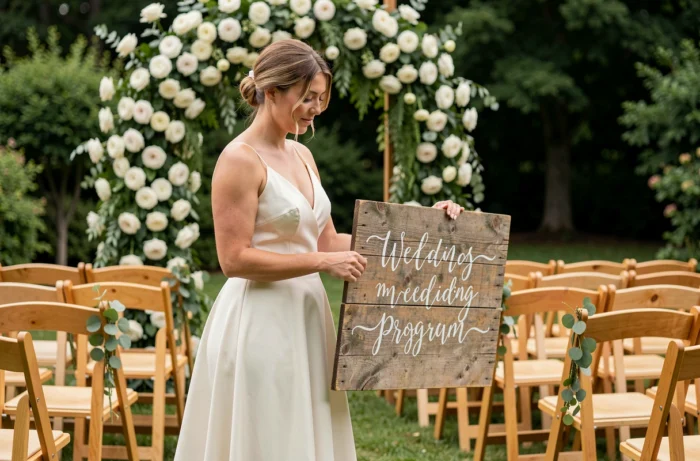
A personalized welcome sign with the couple’s names, a few tall floral arrangements, and soft lighting immediately set the tone. The rest of the hall can remain understated.
The couple’s table as the focal point
This is the only table that all guests will observe during the meal. A textured table runner, candles at varying heights, and vases of different shapes create a richer composition than on the other tables, without the contrast appearing incoherent.
The photo corner as a collective memory
A dedicated space with a decorated backdrop (floral arch, draped fabric, oversized frame) generates photos shared by guests. The decorative investment here yields visibility far superior to that of an additional centerpiece.
The guest tables can suffice with a simple, repeated element: a small bouquet, a candle in a holder, a menu printed on paper coordinated with the theme. The simplicity of the peripheral tables enhances the impact of the main areas.
Wedding personalization: functional objects rather than purely decorative ones
The most sustainable personalization does not come from accessories placed on tables, but from objects that guests use or take home. A seating plan calligraphed on a vintage mirror, engraved place cards with names, a wooden ballot box featuring the couple’s likeness, or a guest book in the form of a participatory puzzle transform decoration into an experience.
This approach has a concrete advantage: functional objects justify their cost through their dual use. A place card that becomes a small gift for the guest replaces both the decorative element and the table memento. A handmade ring box serves during the ceremony and then remains in the couple’s home.
Some personalized elements that combine decoration and function:
- Menus printed on seeded paper that guests can plant after the reception, combining a rustic theme with an ecological gesture
- Bottle labels redesigned with the date and the couple’s names, turning each table bottle into a keepsake
- Personalized scented candles placed as centerpieces, which guests take home at the end of the evening
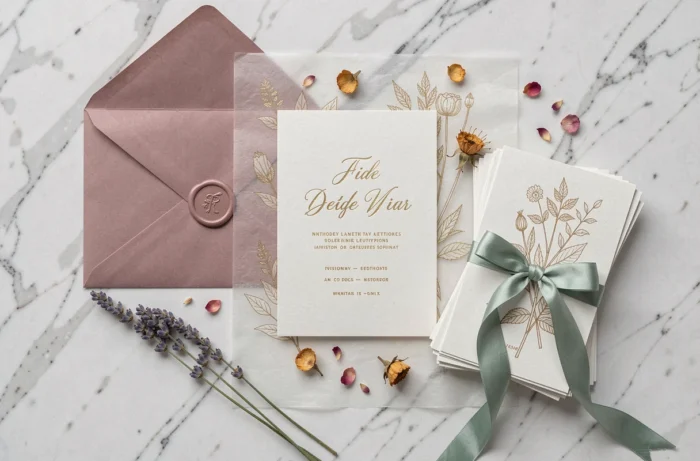
Chic and relaxed wedding decoration: the rise of hybrid atmospheres
The very formal wedding, with immaculate white linens and symmetrical floral arrangements, now coexists with a style that blends elegance and comfort. “Chill” spaces are appearing in receptions: cushions on the floor, blankets on wooden benches, low-hanging fairy lights. The goal is to create an elegant setting where guests can move freely.
This hybrid style relies on choices of soft materials and warm lighting. Natural linens (wrinkled linen, thick cotton) replace taut satin. Candles placed at varying heights create a more irregular warmth than uniform lighting. Mismatched vases, provided they adhere to the same color palette, give a collected-over-time look rather than a purchased-in-bulk appearance.
Field feedback diverges on this point: some very traditional reception venues (castles, vineyards) adapt poorly to overly casual decoration, and the contrast can detract from the whole. Before committing to a bohemian chic or rustic style, checking compatibility with the venue’s architecture remains a step often overlooked.
Personalized wedding table: concrete mistakes to avoid
Table decoration absorbs a significant portion of the overall decor budget. Certain mistakes frequently arise in couples’ accounts after their reception:
- Centerpieces that are too tall, preventing guests from seeing each other and creating a visual barrier throughout the meal
- Overly strong scented elements (highly fragrant flowers, strong aromatic candles) that interfere with the meal
- Unstable decorations on round tables, where the slightest tablecloth movement causes a vase or candlestick to topple
- An excess of small decorative objects that leaves insufficient space for plates, glasses, and cutlery
Testing the actual layout before the big day on a table of exact dimensions allows for identifying these issues. A photo taken at guest level provides a far more reliable perspective than a bird’s eye view on a mood board.
The most successful wedding decoration is one that guests feel without being able to describe. When the ambiance can be summed up in one word (“warm,” “bright,” “intimate”) rather than a list of objects, the guiding principle has worked.