The transition to physiotherapy requires a return to studies of at least four years at a training institute for massage-physiotherapy (IFMK), after a selection year at university. This pathway, governed by the state diploma of masseur-physiotherapist, remains the same whether the candidate comes straight from high school or has a ten-year career in another field.
University selection before the IFMK: the key to understand
No direct admission to the IFMK exists for adults in retraining. First, one must validate a university year among three possible pathways: PASS (Specific Health Access Pathway), L.AS (Health Access License), or the first year of a STAPS license.
The choice among these three pathways depends on the original academic profile. A former scientist will find their bearings in PASS, where biology, physics, and chemistry dominate the curriculum. A literary or sports profile will often have better chances in L.AS or STAPS, where selection also relies on less scientific subjects.
The number of places in IFMK allocated to each pathway varies according to universities and regional agreements. Some faculties reserve the majority of their places for PASS, while others distribute them more equitably. Checking the local distribution before enrolling avoids unpleasant surprises at the end of the year.
For those who wish to become a physiotherapist in professional retraining, this first year is the main obstacle: it requires a full-time commitment, often incompatible with maintaining a salaried job alongside.
Curriculum in IFMK: content and requirements of the four years
Once admitted, the curriculum in IFMK lasts four years and leads to the state diploma, master’s degree. The first two cycles are distinctly different.
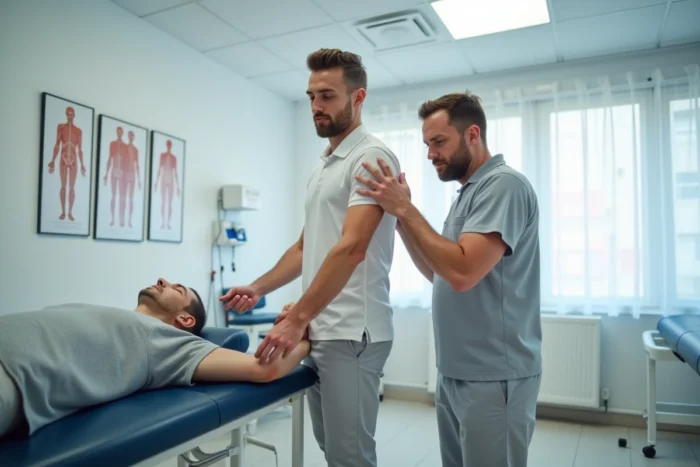
The first cycle (two years) lays the foundations: anatomy, biomechanics, physiology, semiology. Assessments are frequent, with practical exams on mannequins and then on patients starting in the second year.
The second cycle (two years) focuses on clinical practice and specialization. Internships in hospitals, private practices, or rehabilitation centers occupy an increasing share of the time. A research thesis concludes the training.
- Clinical internships represent several hundred hours throughout the curriculum, divided between public and private structures
- Teaching covers musculoskeletal, neurological, respiratory, and pediatric rehabilitation
- The final thesis requires a health research methodology, with a defense before a jury
For an adult in retraining, the weekly workload far exceeds that of a traditional master’s program. In-person classes are mandatory, and internships are non-negotiable. Any parallel professional activity becomes extremely difficult to maintain beyond the first semester.
Funding for physiotherapy retraining: mechanisms to mobilize early
Funding remains the most concrete barrier. Five years of study (one university year plus four in IFMK) without stable income require serious financial planning.
The Professional Transition Project (PTP, formerly CIF) allows employees to retain part of their salary during training, subject to seniority conditions. The application is submitted to Transitions Pro, the regional joint organization. Processing times can take several months.
The CPF (Personal Training Account) rarely covers the entire IFMK curriculum but can fund the preparatory university year or certain supplementary modules. Regional aids sometimes complement the system, depending on the place of residence and local health policy.
- PTP: partial salary maintenance, to be requested at least six months before the start of training
- CPF: usable for the preparatory year, capped amount
- Regional aids: variable depending on territories, often conditioned on a local practice commitment
- Pro-A (retraining or promotion through alternation): accessible under qualification and employer agreement conditions
Specialized retraining guides recommend securing funding even before university enrollment. Starting a PASS or L.AS without financial visibility for the next four years exposes one to the risk of dropping out during the course.
Bridges for healthcare professionals: a real but regulated shortcut
Candidates already holding a paramedical diploma (nurse, podiatrist, occupational therapist, midwife) can apply for direct admission to IFMK, sometimes in the second year. These bridge pathways reduce the total duration of the course.

Each IFMK sets its own eligibility criteria and the number of places reserved for bridge pathways. Selection generally relies on a file, an interview, and sometimes additional tests. The admission rate through this route remains low in most institutes.
For professionals outside healthcare, no direct bridge exists. An engineer, teacher, or salesperson will have to go through the full university year, just like a high school graduate. This reality should be integrated from the project reflection phase.
Practice after the state diploma: liberal or salaried
The state diploma of masseur-physiotherapist opens two main modes of practice. Salaried positions (hospital, rehabilitation center, nursing home) offer a stable framework with defined hours. Liberal practice, chosen by the majority of physiotherapists in France, involves managing a practice, building a patient base, and anticipating social charges.
For a professional in retraining, the skills acquired in a previous life (management, client relations, organization) are a real asset in liberal practice. However, the transition to setting up a practice remains a project within the project, with administrative procedures with the ARS and CPAM taking several weeks.
The pressure on the job market in physiotherapy remains high in many French regions, particularly in rural and semi-rural areas. A qualified physiotherapist generally finds a position within weeks of obtaining their diploma, which secures the exit from training after five years of investment.