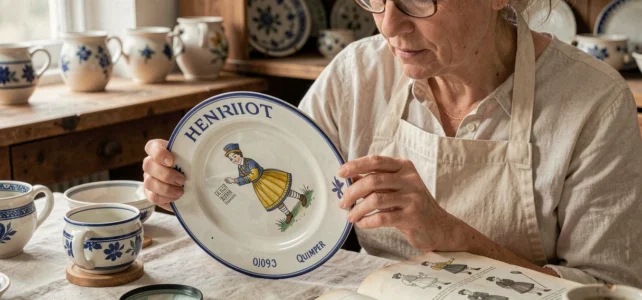
The Henriot Quimper earthenware is a porous ceramic covered with a stanniferous glaze, fired at moderate temperatures. This structure makes it sensitive to shocks, residual moisture, and aggressive chemicals. Maintaining, restoring, or dating these pieces requires understanding their technical fragility before any handling.
Stanniferous glaze and porosity: what makes Henriot earthenware fragile
The clay base of Henriot earthenware remains porous beneath the glaze. If the glaze has the slightest micro-crack, water seeps into the body and causes brown stains or gradual flaking.
The HB-Henriot pottery is still in operation and continues to produce contemporary pieces, sometimes advertised as suitable for everyday use. An antique piece should not be treated like contemporary earthenware. On recent production, the glaze is often more resistant. On an inherited or second-hand piece, the glaze may have endured decades of micro-thermal stresses.
Knowing how to date a Henriot Quimper earthenware helps to adapt the maintenance protocol to the manufacturing period and thus to the probable condition of the glaze.
Routine maintenance of a Henriot Quimper earthenware
The most destructive reflex is putting it in the dishwasher. The combination of heat, water pressure, and alkaline detergent attacks the old glaze in just a few cycles. The result: an irreversible whitish veil over the hand-painted decoration.
Proper cleaning relies on a few simple but non-negotiable gestures:
- Use lukewarm water (never hot) with a neutral soap, such as Marseille soap without additives. Scrub with a soft sponge, without an abrasive side.
- Immediately dry each piece with a soft cloth. Residual moisture migrates into the micro-cracks of the glaze and stains the body deeply.
- Avoid prolonged contact with acidic foods (vinegar, citrus, tomatoes). The old stanniferous glaze reacts to acids that slowly dissolve the surface layer.
- Store plates and dishes with a felt or tissue paper separator between each piece to prevent glaze chips from friction.
Immediate drying is the most protective gesture for an antique earthenware. Most domestic damage comes from air drying that leaves water stagnant on the cracks.
Restoration of Henriot earthenware: distinguishing the repairable from the definitive
A chip of glaze on the edge of a Henriot plate cannot be repaired with standard glue. Cyanoacrylate glues (like Super Glue) leave a yellowed joint in a few months and are nearly impossible to remove cleanly afterward.
Two types of damage call for two different responses.
Crack without loss of material
A stabilized crack (that no longer progresses) can remain as is if the piece is purely decorative. Trying to fill it with an unsuitable putty risks creating a mechanical stress that will prolong the crack.
For a collectible or sentimentally valuable piece, a restoration ceramist uses a slow-setting transparent epoxy resin, applied by capillarity. This work requires controlled drying over several days.
Chip with loss of material
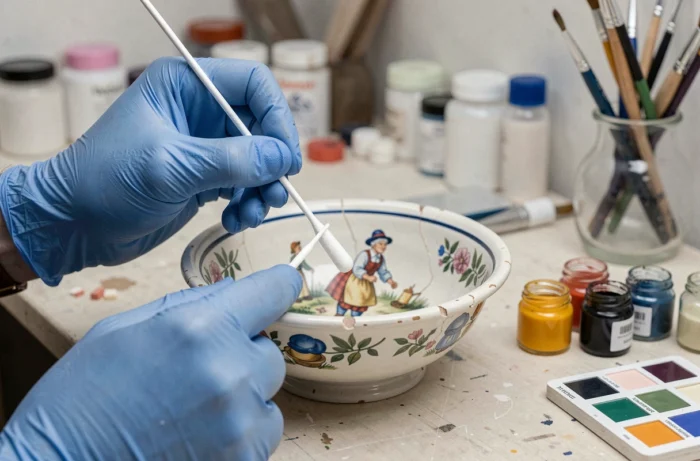
When a piece of glaze or body is missing, restoration involves filling (kaolin-loaded resin), followed by a color touch-up with a brush to restore the continuity of the decoration. Only a restorer specialized in heritage ceramics can reproduce the pigments and texture of the original glaze without altering the piece.
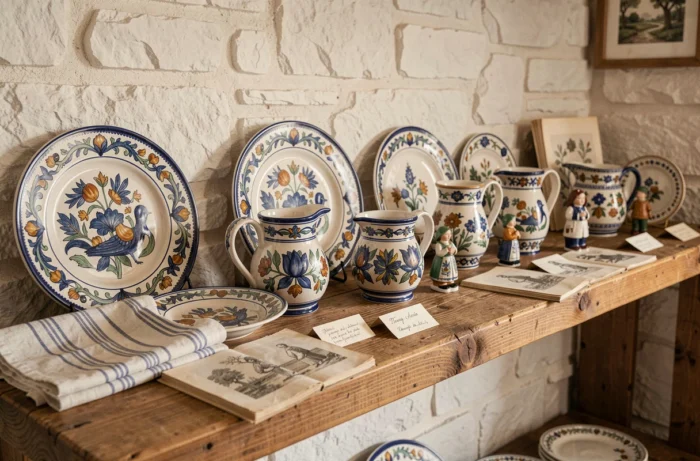
The Quimper Faïence Museum regularly organizes events with contemporary ceramists, where questions of conservation and restoration are discussed. These meetings allow for an examination of a piece and obtaining an opinion on the feasibility of restoration.
Identifying the age of a Henriot earthenware by the decoration and material
Competitors provide extensive details about the marks on the reverse. However, the decoration itself gives clues that the signature alone does not provide, especially when it is erased or illegible.
The irregularity of the painted line distinguishes old pieces from recent productions. On earthenware made before the mid-20th century, each Breton motif (little Breton, Breton woman, rooster, flowers) is hand-drawn with visible variations from piece to piece. The colors are slightly offset from the outlines, and the thickness of the line varies.
On a contemporary piece produced by the HB-Henriot pottery, the gesture remains manual but more consistent, with more homogeneous pigments. This difference is noticeable to the naked eye when comparing an old plate with a new plate side by side.
Complementary clues in the material
Weight also provides an indication. Old pieces often have a thicker and heavier body than recent productions, where molding techniques have refined.
The shade of the body visible under the glaze (at the foot or a chip) varies according to periods. A very light, almost white clay generally indicates a later production. A slightly pink or tawny body points to earlier times.
Finally, the network of cracks in the glaze (called craquelure) is not a defect: it reflects the natural aging of the glaze. A dense and uniform craquelure indicates a piece that has survived several decades. Its absence on a piece presumed to be old should raise concerns about a possible reproduction.
Reliable identification of a Henriot Quimper earthenware thus combines reading the mark on the reverse, analyzing the painted decoration, and physically examining the body. None of these criteria taken in isolation is sufficient, but their intersection allows for situating a piece with a good margin of confidence, even without professional expertise.