
Digital platforms dedicated to women’s rights and diversity have multiplied in recent years. Some originate from international institutions, while others come from coalitions of NGOs or citizen initiatives. Their common point: to make visible local actions that struggle to cross media borders. Mapping these initiatives requires understanding what distinguishes a mere institutional showcase from a tool that is genuinely useful to grassroots actors.
European regulatory framework and online gender-based violence
One of the blind spots in the debate on digital diversity concerns the safety of women on the platforms themselves. Since the general entry into force of the Digital Services Act (DSA) on February 17, 2024, very large online platforms operating in the European Union are required to conduct annual risk assessments covering gender-based violence.
These assessments are not declarative. They require independent audits, increased transparency, and the implementation of documented mitigation measures. For organizations advocating for women’s rights online, this framework is a game changer: it creates a legal lever where only codes of conduct previously existed.
The EU Council adopted specific conclusions on combating cyber-violence against girls on June 29, 2026. These conclusions guide the application of the DSA and the 2024 directive on combating violence against women.
Among the requested measures is the promotion of dedicated funding for organizations acting as “trusted flaggers” specializing in gender-based violence. Associative structures could thus directly report content targeting women to the platforms, with priority treatment.
This regulatory context provides a new foundation for platforms that document and relay women’s initiatives. Their role goes beyond mere networking: they become alert and advocacy relays. This logic can be seen on the Femmes Du Monde website, which aggregates resources related to the journeys and struggles of women in several regions of the globe.
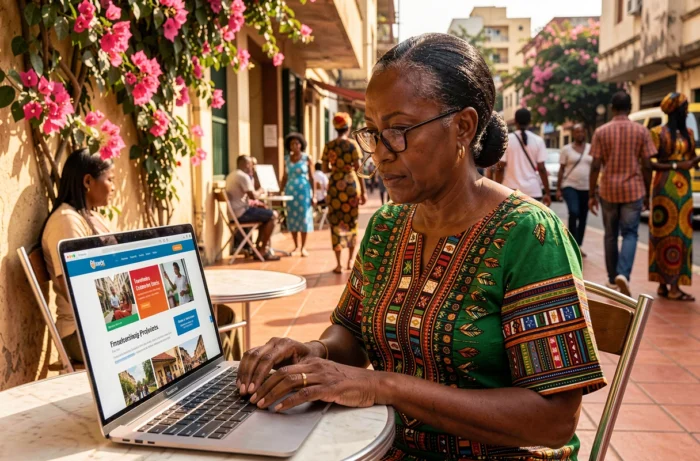
Women’s initiatives and diversity: what existing platforms cover
Platforms dedicated to women do not form a homogeneous block. Some focus on technological innovation, such as the She Innovates program from UN Women. Others target land rights or access to land.
Between these two poles, there remains a poorly covered space: that of local initiatives led by women in underreported sectors. Handicrafts, subsistence agriculture, community mediation, or informal education generate projects predominantly led by women, without any major platform systematically cataloging them.
Generalist platforms attempt to fill this gap by offering thematic maps or directories by country. Their usefulness depends on specific criteria:
- The frequency of content updates, which determines whether the referenced initiatives are still active or have been obsolete for several months.
- The presence of filters by geographical area, by sector of activity, or by type of support sought (funding, mentoring, networking).
- The ability to give a voice directly to project leaders, rather than limiting themselves to descriptive sheets written by third parties.
On this last point, field feedback varies. Some platforms prioritize polished but distant editorial content. Others allow contributors to publish freely, at the risk of uneven quality. No model has yet established itself.
Women’s rights and digital: the limits of online visibility
Giving visibility to the diversity of women’s initiatives is not enough to transform the living conditions of the women concerned. Digital visibility does not replace access to funding or rights. This observation runs through most assessments published by international organizations.
Several structural obstacles persist. In many regions, access to digital technology remains gendered: women are less likely to have a smartphone or a stable connection. Content published on English or French platforms does not reach the communities that need it most.

The linguistic question is rarely addressed in depth. A platform that publishes in French and English covers part of the world but mechanically excludes initiatives led in Arabic, Swahili, or indigenous languages of Latin America. Linguistic inclusion remains a blind spot for diversity platforms.
Additionally, there is a selection bias. Initiatives that gain online visibility are often those that already possess digital skills, an international network, or institutional support. The most isolated projects, led by women far from traditional associative circuits, remain largely invisible.
Gender equality: beyond platforms, what concrete relays
The role of local organizations
Digital platforms function as aggregators, not as grassroots actors. Transformation occurs through local organizations that support women on a daily basis: cooperatives, neighborhood associations, professional support groups. These structures often lack the means to document their own actions and make them visible online.
Funding mechanisms
Funding remains the crux of the matter. The conclusions of the EU Council from June 2026 explicitly mention the need for dedicated funding for specialized organizations. The available data do not yet allow for measuring the real impact of this orientation on allocated budgets.
Platforms could play a role in connecting funders and project leaders, provided they ensure the reliability of the published information. This intermediary positioning requires a rigorous verification of referenced projects, which few platforms currently practice systematically.
- Institutional platforms (UN Women, French diplomacy) offer a legitimacy framework but low local granularity.
- Associative platforms provide ground proximity but suffer from a lack of visibility and technical means.
- Collaborative platforms attempt to combine both approaches, with still uneven results depending on the covered regions.
The multiplication of platforms also poses a readability problem. For a woman leading a project in West Africa or Southeast Asia, identifying the right platform among dozens of competing initiatives is an obstacle in itself. The challenge in the coming years may lie less in creating new platforms than in ensuring the interoperability of those that already exist.