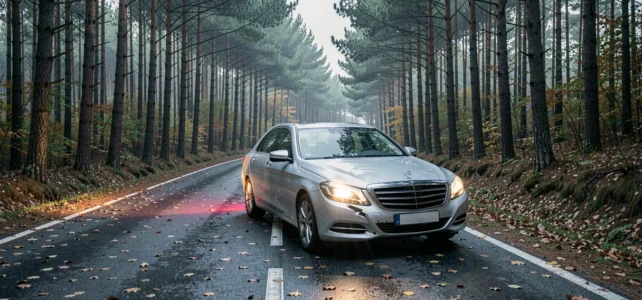
Every year in France, collisions between vehicles and wild boars account for a significant portion of wildlife-related accidents. These incidents most often occur at dusk, on departmental roads lined with forests or fields. The procedure that follows such a collision directly affects how your insurance will handle the claim: without the right reflexes on-site, compensation may be denied or reduced.
1. Immediately secure the scene
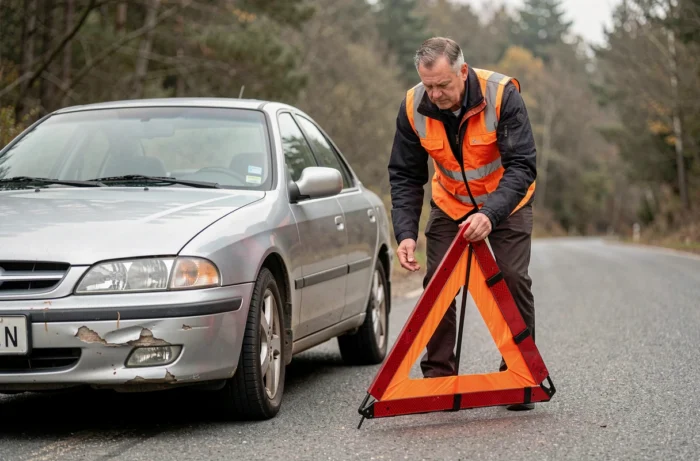
The absolute priority after the impact is not to assess the damage to the bodywork, but to protect the occupants and other road users. An adult wild boar can weigh enough to immobilize a vehicle or push it onto the roadway, creating a potential secondary accident, especially at night.
Move the vehicle to the roadside, as far away from the traffic lane as possible. Activate the hazard lights before taking any other action. Put on your yellow vest inside the vehicle before opening the door, then have your passengers exit on the side opposite to the traffic.
Place the warning triangle at a sufficient distance ahead of the vehicle so that approaching motorists can anticipate the obstacle. On an unlit road, this distance should be generous.
A often overlooked point concerns the animal itself. Even if it is motionless on the ground, a wild boar can react violently if it is merely injured. Never approach the struck animal, do not attempt to move it, and do not load it into your trunk. Beyond the risk of injury, transporting a wild animal without permission poses a regulatory issue.
If you need to delve deeper into the complete procedure for reporting an accident with a wild boar, collecting evidence on-site plays a crucial role in the subsequent handling of the case. Take photos of the vehicle from multiple angles, of the road, of the skid marks, of the animal if it is visible from a reasonable distance, and of any nearby signage (or lack thereof).
2. Alert the authorities to document the accident
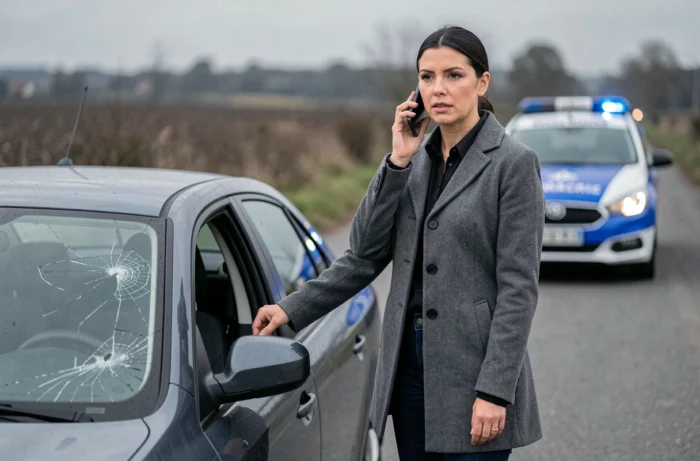
Any collision with a wild animal must be reported to the authorities. Contact the gendarmerie (in rural areas) or the police station (in urban areas), or dial 17. This report is not just a formality: the official report is the key document for your compensation claim.
Without this document, your insurer has no official element to classify the incident as a collision with a wild animal. The risk is that the accident may be reclassified as a road departure or collision with an obstacle, which alters the coverage invoked and may reduce or even cancel the compensation.
On-site, the authorities will assess the circumstances of the accident, note the position of the vehicle, the condition of the road, and the possible presence of the animal. This official report also allows for the carcass to be handled by the relevant services.
In parallel, if there are witnesses present, collect their contact details. Their statements can support your report, especially if the animal disappeared after the collision.
A detail to keep in mind: the absence of a warning sign indicating the presence of wild animals in an area known for their presence may engage the liability of the road manager (State, department, municipality). The authorities’ report also documents this element, which may open up additional recourse.
3. Report the incident to your insurer

Once the scene is secured and the official report is established, the declaration to your insurer should occur quickly. The legal deadline is five working days from the date of the accident. This deadline is imperative: exceeding it may result in a loss of coverage, even if your contract normally covers this type of incident.
The declaration can be sent by registered mail, by email, or via your insurer’s online client area, according to the terms specified in your contract. Attach all supporting documents:
- The report or receipt of the complaint issued by the authorities
- The photographs taken at the scene (vehicle, road, animal, signage)
- The contact details of any witnesses and their statements
- The registration certificate and your insurance certificate
The coverage invoked depends on your level of coverage. With comprehensive insurance, the collision is generally covered under the all-accidents damage guarantee. With third-party insurance, only the “collision damage with an animal” guarantee or the “natural disaster” guarantee may apply, and many third-party contracts do not cover this type of incident at all.
The question of the deductible deserves attention. Even with appropriate coverage, a deductible often still applies. This incident being classified as without an identified third party (the animal has no owner), it does not give rise to a classic recourse. However, if hunters were pursuing the animal at the time of the accident, or if the absence of road signage is documented, recourse against the hunting federation or the road manager remains possible.
Points of caution regarding compensation
An accident with a wild boar does not result in a penalty on your bonus-malus coefficient, as no responsible third party is involved. Your driving history is therefore not affected.
If the vehicle is immobilized, check if your contract includes an assistance guarantee (towing, replacement vehicle). These services are often conditioned on an immediate call to the assistance number on your green card, before involving a breakdown service of your choice.
The rigor of the declaration, the quality of the evidence collected on-site, and adherence to the five-day deadline concretely determine the level of compensation obtained. An incomplete file leaves the insurer with a margin of interpretation that rarely works in favor of the insured.