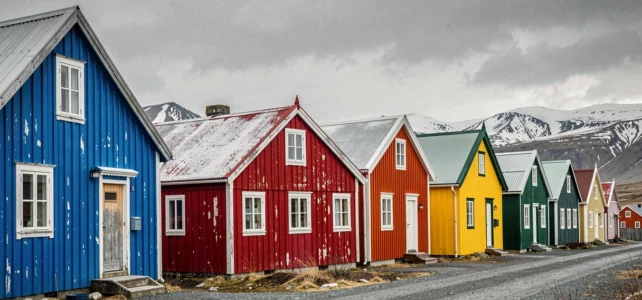
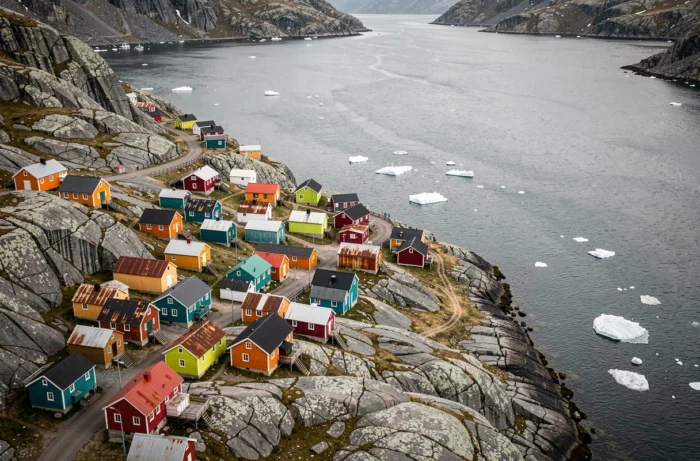
When arriving in Ilulissat or Nuuk by sea, the first visual landmark, well before the signs or docks, is the facades. Bright red, mustard yellow, cobalt blue: each house stands out from the mineral gray and snow like a traffic cone.
This color reflex on Greenland’s houses is not a decorative whim. It responds to very concrete constraints, related to the Arctic climate, Danish colonial history, and an urban identification system that modernization is erasing.
Signage by color: an urban code before street names
Before Greenlandic towns had cadastral maps or reliable postal numbering, the color of a facade indicated the function of the building. This system, imported by Danish colonists, served both residents and visitors arriving in localities sometimes reduced to just a few dozen houses.
The principle was straightforward. A yellow house signaled medical personnel, allowing for the location of a care point during an emergency in the middle of a snowstorm. Red buildings corresponded to shops, schools, or administrations. Other colors identified workshops, fishing warehouses, or private homes of fishermen.
The utility of this system becomes clearer when considering the visibility conditions on site. During the polar night, which lasts several months in the northern part of the island, and during frequent storms, a color code readable from a distance is far more effective than a frost-covered sign. As Inuit homes in Greenland show, this logic of identification by color is found in other northern regions, with local variations.
Wooden houses imported from Denmark: why prefabrication imposed painting
Before Danish colonization, the Inuit of Greenland built their shelters with available materials: seal skins stretched over whale bone structures, clumps of earth, compacted snow. These traditional homes required no paint.
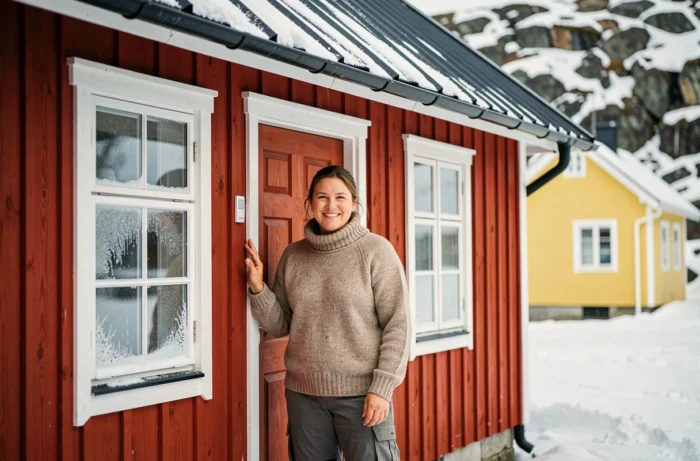
The shift to prefabricated wooden houses, shipped from Scandinavia, changed the game. Raw wood exposed to the Arctic climate degrades quickly. Frost, salty moisture, and strong winds attack the fibers in just a few seasons. Paint primarily protects the wood before decorating the facade. Linseed oil-based pigments, used throughout the Scandinavian tradition, formed a waterproof layer extending the lifespan of the structures.
These standardized, compact, and relatively simple-to-assemble houses gradually replaced Inuit habitats along the entire coastline. Color became the main tool for customizing otherwise very uniform buildings.
A limited choice of shades due to logistics
The pigments arrived by boat, often once or twice a year. The available colors depended on the stock shipped from Denmark. One did not always choose their shade: one took what was available. This logistical constraint partly explains the recurrence of certain colors (Falun red, blue, ochre yellow) and the relative absence of pastel tones in the oldest towns.
Inuit culture and color in Greenland: between tradition and contemporary identity
The original color code has largely relaxed. Strict usages no longer seem normative, and the choice of a shade today depends on personal taste, family tradition, or a desire to stand out. A resident can repaint their house green without it meaning anything about their profession.
Bright facades still play a concrete psychological role. Recent sources emphasize that these colors help make towns less monotonous during long periods of low light. In a region where the winter landscape is almost monochrome, a row of houses painted red, blue, and yellow changes the atmosphere of an entire neighborhood.
This is not insignificant for the morale of the inhabitants. Natural light is lacking for several months each year in localities located above the Arctic Circle. Saturated colors on facades serve as a visual counterpoint to the dominant white and gray.
Arctic habitat and energy efficiency: what color does not show
Greenlandic houses are often reduced to their photogenic facades. However, local architecture meets technical requirements that go far beyond paint.
Recent constructions are designed for energy efficiency in polar environments:
- Compact structures with an optimized surface-to-volume ratio to limit heat loss
- High thermal performance windows, often triple-glazed, sized to capture maximum light without creating thermal bridges
- Heat recovery ventilation systems capable of renewing indoor air without wasting heating energy
- Enhanced sealing against wind and moisture, adapted to the extreme conditions of the coastal ice pack
Greenlandic architecture is primarily a response to the climate, not an aesthetic choice. Color comes afterward, as a finishing layer on a building designed to withstand very low temperatures for long months.
Declining standardization: a color code in the process of disappearing
The original system, where each color corresponded to a specific function, increasingly belongs to the past. Several factors are accelerating this evolution.
The Greenlandic government, in its dynamic of increasing autonomy from Denmark, does not maintain binding regulations on the colors of homes. New constructions escape the historical code. Modern materials (composite cladding, metal sidings) offer a broader palette and do not require the same protective pigments as raw wood.
Tourism has paradoxically frozen the image of colorful houses while contributing to their transformation. Visitors come to photograph the facades of Ilulissat or Sisimiut, prompting some municipalities to preserve traditional shades. Meanwhile, new residential neighborhoods adopt more neutral tones, closer to contemporary Scandinavian standards.
Opinions vary on this point: some residents see color as a colonial legacy to be surpassed, while others view it as a Greenlandic identity marker to be preserved. The land, Inuit culture, and Danish history overlap in every layer of paint.
What is certain is that these facades tell less of a fixed folkloric tradition than of an urban unblocking system, invented out of necessity in an Arctic region where orientation could be a matter of survival. Color was a form of signage before its time, and its gradual disappearance speaks to the ongoing standardization in Greenland.