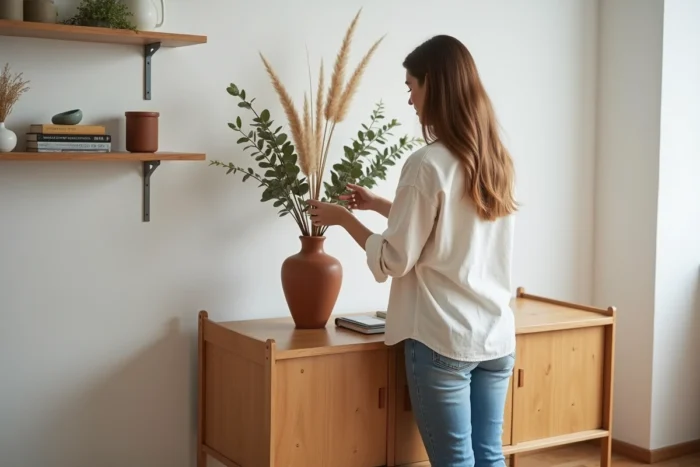
A wall you are not allowed to drill, a floor you must return intact, a lease that prohibits major renovations: most tenants are familiar with these constraints. However, transforming your interior on a daily basis is still possible, provided you prioritize reversible actions and modular solutions. This article details concrete ideas, from acoustics to lighting, to evolve your decor without committing to permanent changes.
Reversible decoration in rentals: the actions that change everything without drilling
Have you ever noticed that a simple change of fabric alters the perception of an entire room? Replacing thin curtains with a thicker fabric, such as linen, transforms both the light and the acoustic atmosphere of a space. Every added textile absorbs sound and softens the ambiance.
No-drill fixings have come a long way. Tension rods, repositionable adhesive hooks, wall-mounted Velcro strips: these accessories now support enough weight to hang frames, mirrors, and small shelves. On the day of the inventory, everything can be removed without leaving a trace.
To further personalize a wall without renovations, repositionable adhesive wallpaper offers an alternative to traditional rolls. It adheres to a smooth surface, peels off cleanly, and allows you to test a color or pattern on a single wall. This type of action, found among La Règle du Je’s home tips, perfectly illustrates the logic to adopt: modify the appearance without touching the structure.
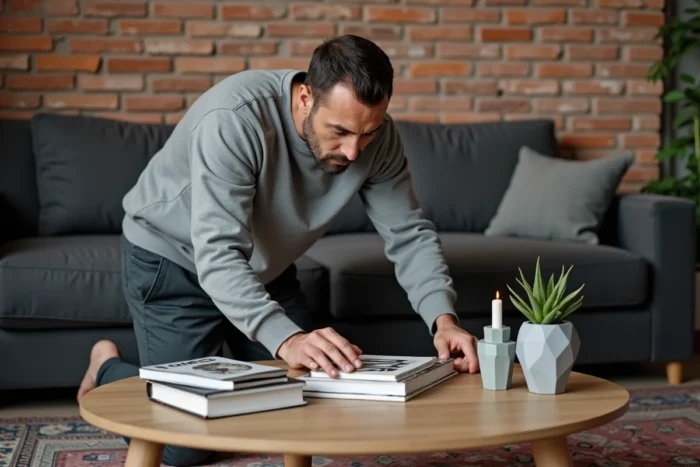
Acoustic layout of the home: modular furniture and mobile dividers
Acoustics is a topic still rarely addressed in decoration content. A room resonates, conversations overlap, and kitchen noise invades the living room. Modular furniture and full-height bookshelves address this issue concretely.
An open bookshelf placed against a shared wall acts as a natural acoustic absorber thanks to the mass of the books. The books, objects, and boxes stored on the shelves break up sound reverberation much better than a flat surface. It’s a simple principle: the more relief and porous materials a wall has, the less sound bounces.
Mobile dividers serve a dual function. They delineate areas in an open space (office corner, relaxation area) and create a physical barrier that dampens sound propagation. A wooden and fabric screen, or a low wheeled unit, is enough to restructure a room without any intervention on the building.
Three modular elements to combine for sound comfort
- A thick rug on the floor, ideally made of wool or dense natural fibers, reduces resonance in tiled or parqueted rooms, which are common in rentals.
- Textile panels suspended by adhesive hooks on a bare wall absorb mid-range frequencies while also dressing the space.
- A mid-height separator, like a cube shelf, filters sound between two areas without blocking natural light.
These solutions can be disassembled and moved during the next move, making them particularly suitable for rentals.
Light and brass details: warming up an interior without touching the walls
Artificial light is the most underestimated lever in rental decoration. A single ceiling light produces flat lighting that flattens volumes. Multiplying light sources (table lamp, floor lamp, LED string lights) creates layers of light that sculpt the space.
Three light points at different heights are enough to change the ambiance of a living room. A low lamp near the sofa, an arc floor lamp above an armchair, and an indirect source placed on a high piece of furniture produce a depth effect that a ceiling light alone cannot achieve.
The choice of finishes also plays a role. Brass stands out as a detail material on handles, faucets, furniture legs, or mirror frames. Compared to chrome, brass emits a warmer tone that warmly enhances a neutral interior without repainting anything. Replacing the handles on a bathroom cabinet with brushed brass models takes just a few minutes and transforms the overall impression of the room.
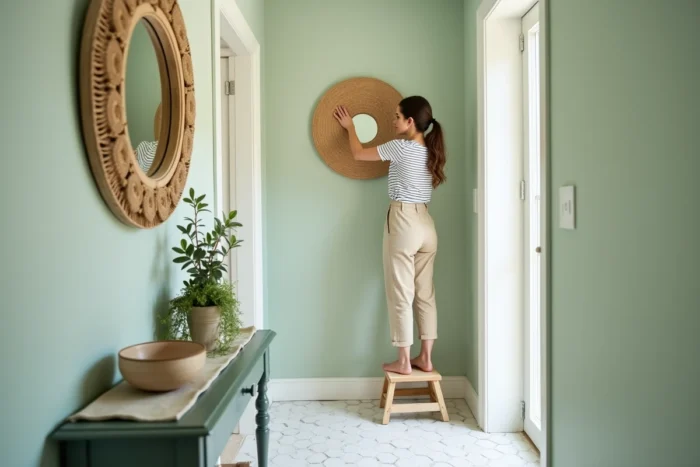
Accent colors without paint
To introduce color without opening a paint can, cushions, throws, and chair covers remain the most direct method. Choosing two complementary shades (a terracotta with a sage green, a navy blue with a mustard) gives a coherent visual direction to the room.
Photo frames and framed posters, placed on a shelf or fixed with repositionable double-sided tape, add a layer of personality. Vary the formats: a large central frame surrounded by two small ones creates a focal point on an otherwise empty wall.
Materials and sourcing: choosing objects that last beyond trends
The dimension of materials and their sourcing is becoming increasingly important in decoration choices. Favoring an object made of solid wood, artisanal ceramics, or locally woven linen is investing in a piece that ages well and retains its aesthetic value over the years.
Wondering why this choice over a low-cost decorative accessory? A natural material object patinas where a synthetic object degrades. A stoneware vase, an olive wood tray, a boucle wool throw retains its appeal after several seasons. This approach goes beyond visual trends to anchor itself in sustainability.
This logic also applies to accent furniture. A raw wood coffee table bought second-hand, sanded and oiled, often costs less than a new equivalent made of particleboard, while offering superior longevity. The same reasoning applies to seating: a vintage armchair in good condition, covered in new fabric, has more character than a standardized model.
Transforming your interior on a daily basis requires neither the landlord’s permission nor a significant budget. Reversible actions, the modularity of furniture, attention to acoustics, and the choice of durable materials form a coherent whole. The next change can start with a simple rug, a repositioned light fixture, or a brass handle. The result is felt from the very first evening spent in the room.