
Buying an organic cotton garment or choosing a local brand instead of an ultra fast fashion label does not stem from the same reflex. Eco-responsible consumers do not form a uniform block: their motivations vary according to their relationship with price, traceability, and recent regulations. Understanding these drivers helps to grasp why sustainable fashion is gaining ground in France, beyond mere ecological discourse.
Textile environmental score: the new benchmark guiding sustainable purchases
Since October 1, 2025, brands can display an aggregated textile environmental score based on 18 indicators: climate, water consumption, aquatic pollution, plastic microfibers, textile waste export, among others. This French framework goes further than the European PEF.
Have you noticed those colored ratings on food packaging? The principle is similar for clothing. The score provides a quick reading of the impact of a pair of jeans or a T-shirt, without having to decipher multiple certifications.
Starting October 1, 2026, if a brand has not published this score, any third party (NGO, association, competitor) will be able to calculate and publish it with default penalizing data. This mechanism creates concrete pressure. Brands that embrace transparency gain credibility, and consumers have a new comparison tool to guide their eco-responsible consumer preferences towards verifiable products.
The environmental score transforms a vague intention into a measurable choice criterion. Previously, “buying responsibly” relied on trust in a label or brand discourse. With this display, comparison becomes possible at the moment of purchase.

Anti fast fashion law in France: how regulation reshapes motivations
The anti fast fashion law, definitively adopted in June 2026, imposes a financial penalty per product on ultra fast fashion platforms, which can reach up to 20 euros per item by 2030, with a cap at 50% of the price excluding tax. The price gap between disposable clothing and sustainable clothing is mechanically narrowing.
This law also bans any advertising for ultra-fast fashion, including through influencers and “haul” videos, starting January 1, 2027. Consumers who were hesitating between two consumption models lose a powerful advertising stimulus.
Why this framework changes the game for the French consumer
Until now, the low price of fast fashion made the transition difficult. A pair of jeans for a few euros versus an organic cotton pair costing several tens of euros, the choice seemed losing for the wallet. The penalty rebalances this scale.
But motivation is not limited to price. The removal of advertising reduces exposure to impulsive purchases. Eco-responsible consumers often cite advertising overstimulation as an obstacle to their sustainable practices. Removing this lever facilitates consistency between conviction and behavior.
Raw materials and manufacturing conditions: what consumers really look at
According to the IFM x Première Vision study conducted in May 2024 with 1,200 consumers per country (France, Italy, Germany, United Kingdom, United States), what best defines a responsible fashion item for French consumers aged 25-34 is primarily the materials used (33%), followed by environmental protection (32.4%). Social manufacturing conditions come in third place (18.8%).
This ranking reveals a often underestimated point: the social dimension remains secondary in the hierarchy of motivations. Eco-responsible consumers in France prioritize what they can quickly verify or understand, namely the fabric composition.
- Natural or recycled materials are perceived as a tangible guarantee of sustainability because they appear on the label and can be easily compared between two products.
- Environmental protection functions as a framework value: it motivates purchase without always translating into precise verification by the consumer.
- Social manufacturing conditions (wages, workshop safety) remain more abstract and difficult to assess at the time of purchase, which explains their lower position.
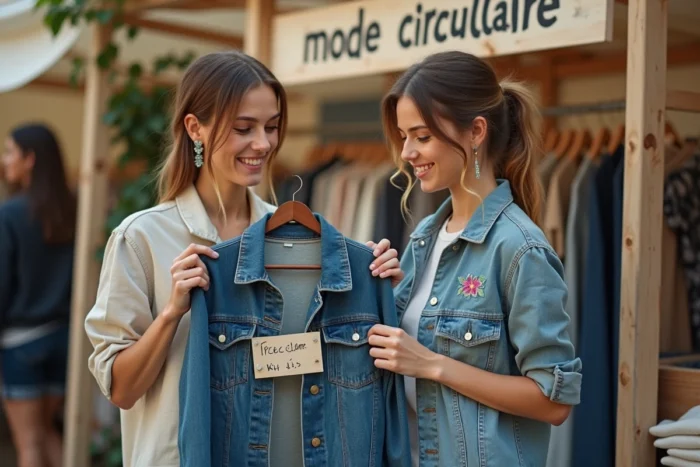
The paradox of recycled clothing
Despite the expressed interest in ecological materials, clothing made from recycled materials struggles to convince. The image of “recycled” remains vague for part of the public. Some consumers still associate textile recycling with inferior quality or a lack of durability in the finished product.
The challenge for brands is to make recycled products as desirable as new ones. Transparency about transformation processes and the lifespan of the garment can alleviate these hesitations. Brands that precisely document the origin of their recycled fibers and the results of durability tests achieve better conversion rates.
Sustainable fashion and price: a barrier that evolves with ecological awareness
Price remains the primary obstacle cited by consumers who do not buy sustainable fashion. Why does this barrier persist even as ecological awareness grows?
The answer partly lies in the mental calculation made by the consumer. A sustainable garment costs more upfront, but its lifespan is often longer. The cost per use of a quality garment is frequently lower than that of a disposable garment. This reasoning is gaining traction, especially among young adults who are already practicing second-hand shopping.
The IFM x Première Vision study shows that the majority of young French adults have purchased responsible products for themselves. The ecological transition in fashion is no longer a niche: it concerns a growing share of buyers, even if the act of purchasing remains conditioned by the available budget.
The combination of the penalty on fast fashion, mandatory environmental labeling, and the end of advertising for disposable fashion creates a structuring context for eco-responsible motivations. The French consumer who wants to buy better now has regulatory and informational tools that did not exist two years ago.
The next step will be to measure whether these mechanisms actually accelerate the decline in the volume of new clothing purchases, or if they simply shift consumption to other segments.