
A dripping faucet, a shelf to fix, a wall to refresh: these small DIY tasks at home seem accessible to everyone. Most of them are, as long as you know where the slippery ground begins. Between the tip that saves time and the task that requires a qualified professional, the line is thinner than you might think.
When DIY at home turns into a real risk
Have you ever noticed that an online tutorial rarely shows the consequences of a wrong move? Reconnecting a light fixture, replacing an outlet, adjusting a water supply pipe: these tasks seem simple. However, they fall outside the realm of small DIY as soon as they involve electricity or plumbing.
In France, services referred to as “small DIY” are defined as basic and occasional tasks. Their duration usually does not exceed two hours. Beyond that, or as soon as the work requires building expertise, you enter the domain reserved for qualified craftsmen.
The installation of electrical systems, masonry, the installation of partitions, or the renovation of a bathroom do not fall under domestic DIY. These activities require specific skills, qualifications, and appropriate insurance. Ignoring this exposes you to concrete legal risks: in the event of a disaster, your home insurance may refuse coverage if the work was not done according to the rules.
A good reflex is to look for the appropriate references for each project on briconet.fr, which allows you to quickly distinguish between what falls under domestic tips and what requires a certified professional.

DIY tools: building a useful toolbox without breaking the bank
Before discussing techniques, let’s ask a practical question: how many tools do you actually use more than once a year? The answer often hovers around a handful. Starting from your real needs avoids accumulating equipment that collects dust.
The basics that cover most small jobs
- A five-meter tape measure, a spirit level, and a carpenter’s pencil: these three items are useful for every project, from assembling furniture to hanging a frame
- A cordless drill-driver with a set of bits for wood, metal, and concrete, which alone replaces screwdrivers, hand drills, and augers
- A set of flat and Phillips screwdrivers, a 300-gram hammer, and a pair of pliers, for everything that doesn’t justify getting the drill out
- A retractable blade cutter and safety glasses: safety comes before speed
With this kit, you cover assembly, fastening, simple cuts, and regular maintenance. Each additional tool should meet a specific project need, not a desire to buy.
Choose based on use, not brand
A budget screwdriver will serve its purpose for years if you use it three times a month. In contrast, a low-end drill used weekly will quickly show its limits. Invest in the tools you use often, and choose entry-level for the rest.
Tips for successfully completing your projects step by step
Successful DIY relies less on manual skill than on preparation. A failed drilling in drywall rarely comes from a bad tool. It comes from poor marking.
Prepare the surface before drilling or fixing
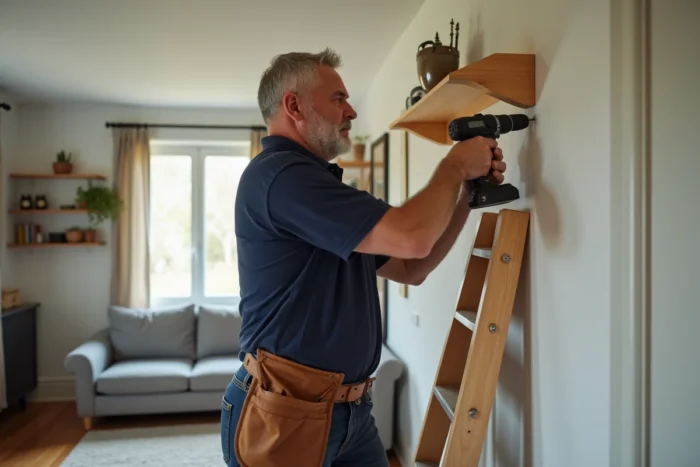
Before drilling a wall, identify what’s behind it. A stud finder (available for a few dozen euros) detects metal structures, wood, and electrical cables. Never drill a wall without checking for the absence of conduits.
On drywall, use anchors suitable for the load. A shelf loaded with books requires Molly anchors or toggle bolts, not simple plastic anchors. On concrete, switch to percussion mode on your drill and choose a concrete bit with the exact diameter of the anchor.
Painting without streaks: preparation makes the difference
Painting is the most common DIY project and the one that generates the most disappointments. The reason rarely lies in the quality of the paint itself.
A well-sanded and dusted wall absorbs paint evenly. Apply a primer if the surface is new, porous, or stained. Use an appropriate roller (short nap for smooth surfaces, long nap for textured surfaces) and cross your passes starting from the top of the wall.
Masking tape should be applied to dry, clean surfaces. Remove it before complete drying to avoid paint peeling.
Common DIY mistakes and how to avoid them
Some mistakes recur in every home project. Knowing them before starting saves time and protects the material.
- Tightening a screw too hard in soft wood: the threading loses its grip and the fastening becomes unstable. Stop screwing as soon as the head is flush with the surface
- Neglecting ventilation during painting or sanding work: fine particles and volatile organic compounds accumulate quickly in a closed space. Open at least two windows to create a draft
- Ignoring noise regulations: local decrees regulate the hours for noisy DIY work. In Loire-Atlantique, for example, a specific prefectural decree governs neighborhood noise regulations. Check with your town hall before starting a project on the weekend
Noise remains the primary source of conflict between neighbors related to DIY. Inform your neighbors if your work lasts more than a day. This simple gesture avoids a lot of tension.
Knowing how to delegate: the true guide for the informed DIYer
An effective DIYer knows how to recognize the limits of their skills. Assembling a flat-pack furniture, replacing a faucet washer, hanging a curtain rod: these tasks can be managed without outside help with a minimum of method.
Installing a fitted kitchen, modifying an electrical circuit, or creating an opening in a load-bearing wall fall into another category. These tasks involve the building’s structure or the safety of the occupants. Entrusting these projects to a qualified craftsman protects your home and your liability.
Between the two, there exists a gray area. Laying wall tiles in a small bathroom is doable as a self-taught task. Completely redoing the waterproofing of a walk-in shower, much less so. The decision criterion is simple: if a mistake on your part could cause water damage, a short circuit, or a structural problem, delegate.
The most useful DIY tips and advice do not focus on how to do everything yourself. They focus on the ability to assess each project with clarity, to choose the right tools for the right tasks, and to call a professional when the situation demands it.