
Marriage after 70 is not merely a symbol or a matter of nostalgia. It is a legal act that modifies taxation, inheritance, and the social rights of the couple. Unlike PACS or cohabitation, marriage opens mechanisms for the protection of the surviving spouse that do not exist in any other legal framework in France. Understanding these mechanisms helps to explain why couples over 70 take the step for very concrete reasons.
Survivor’s Pension: The Right Guaranteed Only by Marriage
The survivor’s pension is the primary financial lever of senior marriage. It allows the surviving spouse to receive a portion of the deceased’s pension. Neither PACS nor cohabitation grants this right, regardless of the number of years of cohabitation.
Under the general scheme, remarrying after 70 does not automatically result in the loss of this right. Retention depends on the survivor’s income conditions. However, in the complementary Agirc-Arrco scheme, remarriage leads to the permanent loss of the survivor’s pension linked to a deceased former spouse.
This difference between schemes radically changes the strategy. A widower or widow receiving an Agirc-Arrco survivor’s pension from a first marriage must decide: does the benefit of a new union compensate for the loss of this complementary pension? The calculation varies depending on the amounts involved, and consulting a retirement advisor before making any decisions can prevent irreversible surprises.
Choosing senior marriage at 70 thus involves both financial and emotional reasoning, where each pension scheme weighs differently in the balance.
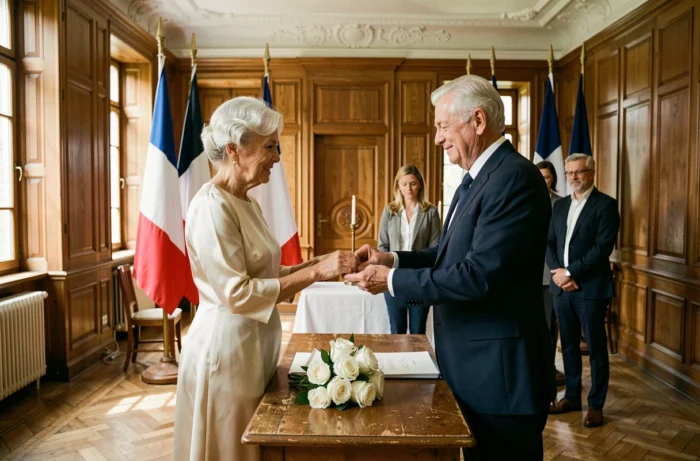
Marriage Contract and Inheritance After 70: Protecting Without Disinheriting
The meeting with the notary before the ceremony is not an administrative formality. It is the central piece of the arrangement. Without a contract, the default regime remains the community of property, which can create conflicts between the new spouse and the children from a previous union.
Separation of Property and Preemption Clause
The separation of property regime preserves the assets accumulated before marriage. Each spouse retains full ownership of their prior assets. To go further, a preemption clause allows the survivor to keep certain common assets (the home, for example) before any inheritance distribution.
This clause prevents the surviving spouse from being forced into joint ownership with reserved heirs. It protects the daily living environment without infringing on the children’s hereditary reserve.
Donation Between Spouses
The donation to the last surviving spouse expands the options for the surviving spouse at the time of inheritance. It allows them to choose between the usufruct of all assets, one-quarter in full ownership and three-quarters in usufruct, or another combination provided by law. Without marriage, this donation is impossible.
Combined with a separation of property contract, it offers a tailored structure. The notary adapts the clauses to the family composition, making each contract unique.
Taxation of the Senior Married Couple: Allowances and Joint Taxation
Marriage creates a joint tax household. For two retirees with similar incomes, the effect on income tax can be neutral. However, when the income gap is significant, the pooling of tax brackets reduces the overall tax burden.
The most significant advantage lies in inheritance. The married spouse benefits from a total exemption from inheritance tax, regardless of the amount transferred. Neither the PACS partner (also exempt from inheritance tax, but without access to the survivor’s pension) nor the cohabitant (taxed at 60%) accumulates these two protections.
Here are the main tax advantages reserved for the married spouse:
- Total exemption from inheritance tax between spouses, without a ceiling
- Joint taxation on income with smoothing effects on brackets
- Possibility to attach certain deductible expenses to the joint household (dependency expenses, home employment)
Life Insurance and Marriage: An Often Underestimated Duo
Life insurance remains a tool for transmission outside of inheritance. Designating one’s spouse as the beneficiary of a contract taken out after marriage enhances the financial protection of the survivor, beyond what the legal inheritance provides.
For payments made before the age of 70, each beneficiary enjoys a specific allowance on the capital transmitted. After 70, the rules change: only premiums paid above a certain global threshold are subject to inheritance tax, but the generated interest remains exempt.
Combining marriage and life insurance secures the spouse on two fronts: legal inheritance (via the donation to the last surviving spouse) and extra-inheritance transmission (via the life insurance contract). This double protection is inaccessible to unmarried couples who do not have access to the survivor’s pension.

The motivations behind a marriage at 70 and beyond far exceed the sentimental realm. Survivor’s pension, inheritance, taxation, life insurance: each legal mechanism operates differently depending on the couple’s status. Marriage remains the only legal framework that activates all of them simultaneously. A prior notarial appointment, complemented by a retirement assessment, transforms this emotional choice into a structured financial decision.