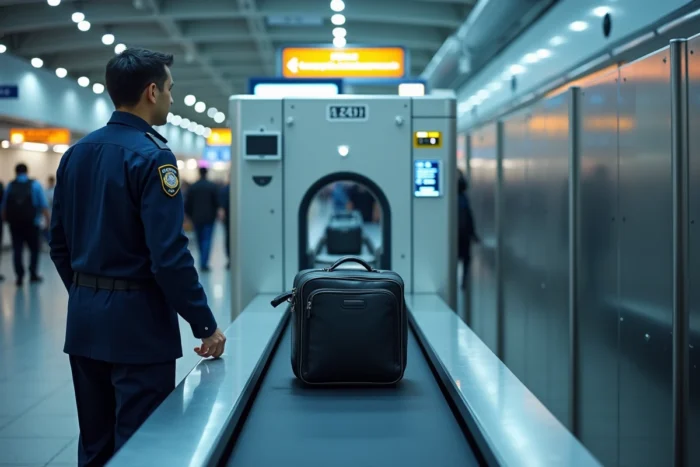
Airport security scanners use dual-energy X-rays to analyze the density and composition of objects placed in cabin trays. Banknotes, although thin individually, form a uniform low-thickness mass that is easily identifiable on the operator’s screen. In other words, yes, cash is visible on the scanner, but it is not the primary target of the security device.
X-ray Radiographic Signature of Banknotes
A modern banknote contains several layers of specific materials: cotton fibers, polymers, metallic security threads, and inks with magnetic or infrared properties. Under X-rays, these components create a signature distinct from that of regular paper or fabric.
In practice, a bundle of banknotes appears as a dense and homogeneous block, clearly different from a book or a folded piece of clothing. Security agents trained in reading radiographic images easily spot this shape, even when the banknotes are slipped into an envelope or spread across several pockets of a bag.
The dual-energy technology allows for distinguishing organic materials from inorganic materials. The security threads integrated into the banknotes (present in euros as well as most currencies) produce a metallic contrast that further enhances visibility. Hiding banknotes among clothing does not make them invisible: the density contrast remains striking on the screen.
Field reports show that agents identify bundles even before opening the luggage. Any unusual or dense content triggers a manual inspection, and a packet of banknotes falls into this category. This applies to both cabin baggage and checked luggage, the latter also passing through an X-ray scanner before loading.
To better understand how detecting cash at the airport scanner actually works, it is important to distinguish between security and customs, two controls with very different purposes.

Airport Security and Customs Control: Two Distinct Systems for Cash
The security scanner looks for dangerous objects: weapons, explosives, non-compliant liquids. An agent who spots a bundle of banknotes has no obligation to report it to customs. Their role is limited to verifying that the object does not pose a threat to flight safety.
The detection of cash falls under customs control, which occurs at a different point in the passenger journey. Customs officers have their own tools and procedures, and it is at this stage that transporting large sums becomes a legal issue.
Declaration Threshold in France and the European Union
Regulations require a mandatory declaration when a traveler carries cash beyond a certain threshold, whether entering or leaving the territory. This obligation covers banknotes, but also traveler’s checks, money orders, and certain financial instruments.
- Failure to declare may result in partial or total seizure of the amounts carried, along with a fine proportional to the undeclared amount.
- Customs officers can intervene at any point in the airport journey, including after security checks or upon arrival, based on intelligence or random checks.
- Millimeter-wave body scanners, used in some airports, also detect objects hidden on the body, including bundles of banknotes placed under clothing.
This type of control exists in the majority of countries.
Security Inks and Detection Technologies Specific to Banknotes
Beyond X-rays, banknotes incorporate detection technologies that do not directly concern airport scanners but are worth understanding to grasp the entire system.
The infrared and magnetic inks integrated into banknotes are primarily used for authenticity verification by banks and machines. Under infrared light, certain areas of the banknote become visible while others disappear, creating a characteristic pattern that is impossible to reproduce with a standard printer.
Standard metal detectors, those in the form of arches that every passenger walks through, do not react to banknotes in normal quantities.
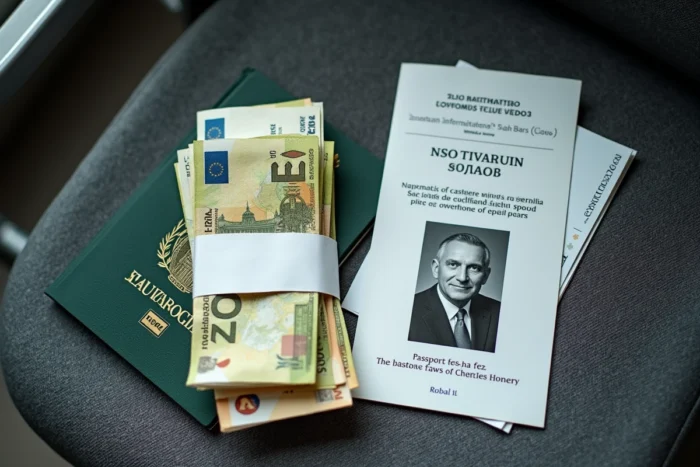
Transporting Cash by Plane: Concrete Mistakes to Avoid
Distributing banknotes across several bags or mixing them with clothing is not an effective strategy. Scanners analyze each bag individually, and a bundle remains identifiable regardless of its position in the bag.
Placing cash in a transparent plastic bag, as is required for liquids, is not mandated by any regulation. Keeping banknotes in cabin baggage rather than checked luggage is preferable for obvious security reasons in case of loss or theft of the bag.
- Do not attempt to hide cash in food containers or hollow objects: security agents are trained to spot density inconsistencies, and this behavior will systematically trigger a manual search.
- Prepare the customs declaration form before arriving at the airport if you are carrying a large sum, rather than trying to go unnoticed.
- Keep proof of the source of funds (bank statement, sales contract): in case of a customs check, the absence of documentation worsens the situation.
Transporting cash by plane is legal and common. The obligation is on the declaration, not on the transport itself. A traveler who correctly declares their funds faces no consequences, even for large amounts.
Airport scanners see the banknotes, agents know how to recognize them, and customs have additional means to identify passengers carrying undeclared sums. Transparency remains the only approach that works.