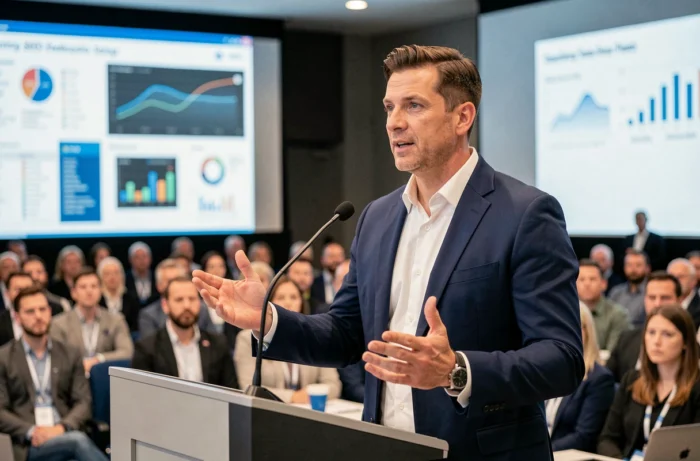
The shift from traditional SEO to GEO (Generative Engine Optimization) reshuffles the cards of organic visibility. At TeknSEO 2026, Cédric Guérin presented a methodology that integrates this shift, relying on concrete cases from Rennes-based sites whose traffic no longer depends solely on traditional Google rankings. Here, we analyze the key technical points of this presentation and their implications for SEO practitioners.
Tracking AI Citations: The Metric SEO in Rennes Must Integrate
AI Overviews and responses generated by Perplexity or ChatGPT cite sources without generating clicks systematically. The problem for an SEO consultant is not the absence of a link, but the inability to measure the actual exposure of a brand in these responses with the usual tools.
Cédric Guérin presented a monitoring protocol at TeknSEO that cross-references crawl data from generative responses with server logs. The goal: to identify when content is cited by a language model, even without redirection to the source site. This approach requires structuring content so that it is extractable by LLMs, fundamentally altering SEO writing.
In Rennes, agencies like Yumens and Voyelle are already offering visibility audits in generative responses. The specificity of Guérin’s approach lies in the coupling of this tracking with strategic arbitration: should we increase AI citations or, conversely, activate withdrawal mechanisms to protect content reuse? When discussing SEO in Rennes with Cedric Guerin at TeknSEO 2026, this question of editorial control becomes a fully-fledged strategic axis.

AI Act and SEO Content Compliance Since August 2026
Article 50 of the AI Act has imposed since August 2, 2026, transparency obligations on synthetic content concerning topics of general interest. For sites that use large-scale text generation, the question is no longer technical but legal.
An exemption exists when substantial human editorial control and identifiable responsibility are demonstrated. In practice, this means that an AI-assisted SEO content production workflow remains compliant as long as human intervention is documented at each stage.
We observe that most SEO agencies have not yet adapted their processes. The risk is not immediate (sanctions remain gradual), but Google is already devaluing content assembled without real editorial input. Google’s guideline does not penalize AI as such, but rather the mass production practices devoid of added value. Content that is generated, reformulated, or assembled without original information or identifiable verification loses visibility.
What This Changes for an SEO Consultant in Rennes
For a practitioner like Cédric Guérin, the AI Act adds a layer of compliance to the usual specifications. Deliverables must now include traceability of the editorial process, not just positioning metrics. This is a change in posture: the SEO consultant becomes responsible for the regulatory compliance of the content, not just its performance in the SERPs.
GEO Optimization in Rennes: Structuring Content for Generative Engines
GEO requires a redesign of how we structure information. Language models extract responses from identifiable semantic blocks. Content optimized for GEO is not just good SEO content with schema tags: it is content where each paragraph answers an implicit question autonomously.
Specifically, the method presented by Cédric Guérin is based on several technical axes:
- Systematic division of pages into unitary response blocks, each of which can be extracted and cited out of context without loss of meaning
- Use of enriched structured data (FAQ, HowTo, Dataset) to facilitate extraction by crawlers of generative engines
- Analysis of long conversational queries that feed AI Overviews, with mapping to local search intents specific to Rennes and Brittany
- Implementation of dedicated tracking to distinguish classic organic traffic from visits resulting from citations in AI responses
The last point is the most complex to implement. Referrers from generative engines are not always identifiable in standard analytics tools. It is necessary to cross-reference multiple data sources to obtain a reliable picture.

Data Analysis and Advanced Excel: The Underestimated Tool of Technical SEO
An aspect rarely addressed in SEO conferences, yet central to Cédric Guérin’s practice: advanced mastery of Excel for processing crawl and positioning data. At TeknSEO, part of the demonstration focused on leveraging large datasets (server logs, Search Console exports, crawl results) without resorting to expensive third-party tools.
The approach involves building pivot tables and conditional formulas that automate the detection of anomalies: orphan pages, keyword cannibalization, drop in indexing coverage. For an SEO agency or freelance consultant in Rennes, this skill reduces dependence on SaaS subscriptions and allows for a level of customization that pre-configured dashboards do not offer.
From Spreadsheet to SEO Strategy
Raw analysis is worthless without interpretation. What distinguishes an experienced consultant is the ability to transform columns of data into content and internal linking decisions. Cédric Guérin emphasizes that every SEO recommendation must be traceable to a data point, not to an intuition or a generic “best practice.”
Natural referencing in 2026 demands this analytical rigor, especially as Google results fragment between classic links, AI Overviews, and enriched panels. SEO consultants who cannot leverage their own data lose relevance against automated tools that do not understand the business context of a Rennes client.
The TeknSEO 2026 conference confirmed that the role of an SEO consultant in Rennes is no longer limited to optimizing title tags and building links. Visibility is now played out on multiple simultaneous fronts, from classic positioning to citations in generative responses, with a layer of regulatory compliance added to the scope. Cédric Guérin is among the practitioners who have anticipated this shift, and his results in the Breton field confirm it.