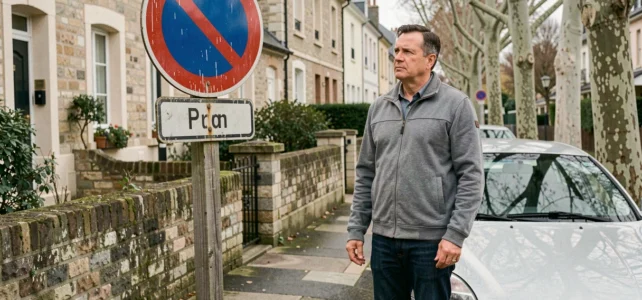
A neighbor parks his van right in front of your gate every morning. You fume, you stick a note on the windshield, you consider concrete blocks. The reflex is understandable, but public roads do not function as an extension of your property. Parking in front of a house follows specific rules from the Highway Code, and they apply to everyone, including the homeowner.
Driveway and curb cut: the legal tipping point
Two situations are often confused. Parking in front of the facade of a house without vehicle access is legal on public roads. Parking in front of a driveway (gate, garage, path) is prohibited, even without a sign and even if you are the owner.
Article R417-10 of the Highway Code establishes this prohibition automatically. The presence of a curb cut (the “curb cut”) is enough to characterize the driveway. No sign is necessary for the offense to exist. The Court of Cassation has confirmed it: the owner of the access has no special privilege to park in front of his own gate.
The legislation on parking in front of a house is based on this fundamental principle: the public road belongs to no one, not even to the immediate neighbor.
Inconsiderate, very inconsiderate, dangerous parking: three distinct levels of penalties
Competing articles treat inconsiderate parking as a single block. In practice, the Highway Code distinguishes three categories, and the difference affects the fine.
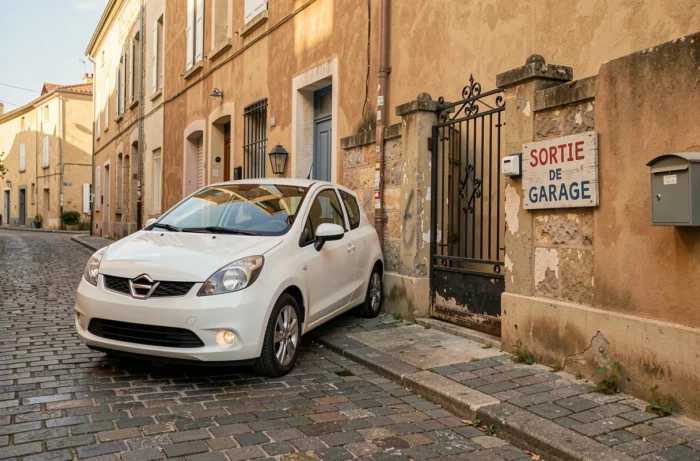
- Inconsiderate parking (article R417-10): blocking a driveway, parking in front of a fire hydrant, or double parking. Class 2 offense, with a fixed fine of 35 euros, increased to 75 euros in case of late payment.
- Very inconsiderate parking (article R417-11): parking on a sidewalk, a pedestrian crossing, a bike lane, or a space reserved for disabled persons. Class 4 offense, fixed fine of 135 euros.
- Dangerous parking (article R417-9): parking in a curve, at the top of a hill, or near an intersection without visibility. Class 4 offense as well, but with a withdrawal of three points from the license.
Driving onto the sidewalk to “not obstruct traffic” is therefore a false good idea. You go from a class 2 offense to a class 4 offense, with a fine almost four times higher.
Abusive parking in front of your home: the seven-day rule and municipal orders
A vehicle that doesn’t move for weeks in front of your house poses another problem. The Highway Code qualifies as abusive parking any vehicle left in the same spot on public roads for more than seven consecutive days.
What field reports show is that some municipalities reduce this period by municipal order. In tourist areas or narrow streets, the town hall can set a maximum duration shorter than seven days. These provisions can be found in local traffic orders, available at the town hall or on the municipality’s website.
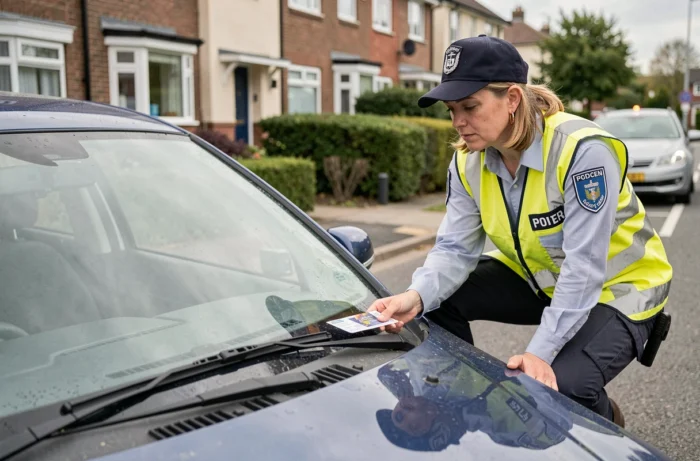
The procedure remains the same in all cases: reporting to the municipal police, on-site verification, then a formal notice to the vehicle owner. If the vehicle is not moved, it may be towed.
Junk or abandoned vehicle: two different regimes
A vehicle parked for a long time is not necessarily a junk vehicle. The junk vehicle refers to a vehicle that can no longer circulate (expired technical inspection, lack of wheels, advanced state of degradation). The mayor can then order its removal without going through the seven-day period, relying on his police powers.
An abandoned vehicle in working condition, however, remains subject to the regulatory period. The distinction matters if you are looking to have the town hall intervene quickly.
Public road and private space: the trap of confusion
The most common mistake is to believe that the end of the sidewalk in front of one’s house is part of one’s property. The cadastre clarifies: the sidewalk and the roadway fall under the communal public domain, even when the adjacent owner maintains the grass between the gate and the curb.
Conversely, if a vehicle is parked on your private property (in your yard, on your driveway), the Highway Code no longer applies. We switch to civil law, with a procedure for unauthorized occupation. The deadlines and remedies are then completely different.
This distinction has a direct practical consequence. Placing blocks, chains, or planters on the sidewalk in front of your home to “reserve” a spot is an illegal occupation of the public domain. The town hall can demand their removal and issue a report.
Requesting a reserved space: the only legal avenue
For people with reduced mobility, a request for a reserved space can be submitted to the town hall. Outside of this case, no neighbor can obtain the allocation of a parking space in front of their home on public roads. Feedback varies on this point depending on the municipalities, but the principle remains the same everywhere.
Parking in front of a house is a shared right, governed by rules that protect both the neighbor and the passerby. The Highway Code makes no distinction between the homeowner and any other driver. In front of a driveway, everyone is in violation. On the free roadway, no one can claim the spot.